
Inert Gas
-
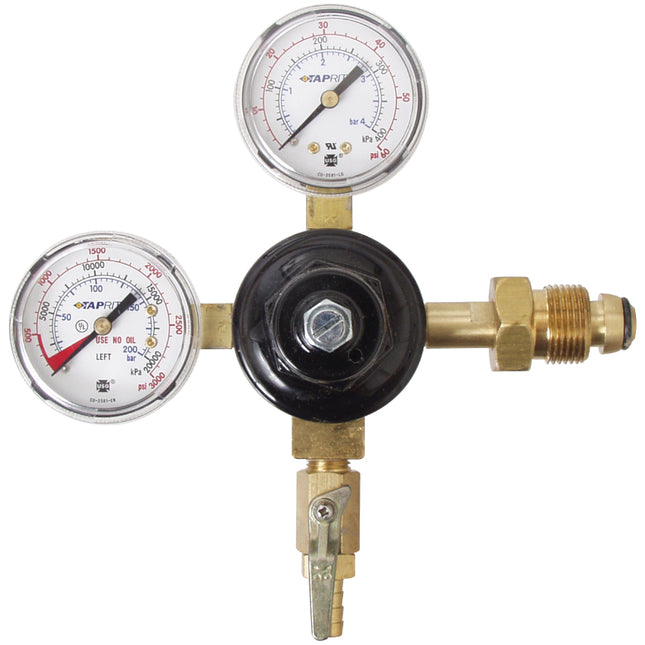
Taprite Dual Gauge Nitrogen Regulator | Argon | Beer Gas Mix | 0-50 PSI Working Pressure | CGA580 Inlet | One Way Shutoff Valve | 5/16" Barb Outlet
A nitrogren regulator used for Nitrogen and Argon - it will fit both tanks. A nitrogen regulator has a higher high-pressure gauge than a CO2 regulator. (The starting pressure in a Nitrogen/Argon tank will be about 2200 p.s.i. as opposed to 800 p.s.i for a CO2 tank.) CGA580. Tap-Rite brand nitrogen regulator. 5/16" barb. For more information on using gas for flushing vessels, please refer to MoreWine!'s Guide to Inert Gas in Winemaking
$129.99
-


Inert Gas Bottle Sparger
Keep your wine from oxidizing! This is one of the most prized possessions of our in-house wine maker. He uses Argon because of its high molecular weight, but CO2 will work. From extended macerations (he gasses before and after laying plastic wrap over the cap) to topping up storage tanks (he uses before setting the floating lid), this is a great way to make sure no excess oxygen is getting into your wine. This can also be used to purge any tank before filling with the wine. Designed to mate with an H550B Quick disconnect installed in the standing end of your 5/16" gas line (H550B and gas line not included).
$44.99
-

Vinyl Beverage Tubing | Rigid | Draft Line | 3/8 in. ID | 5/8 in. OD
3/8 in. ID Beverage Tubing Technical Specifications: 3/8" line provides .20 lbs of restriction per foot. Ideally pounds of resistance should equal pounds of applied pressure. 3/8" line holds 3/4 of an ounce per foot. Made from PVC. Outer diameter of tubing is approximately 5/8"
$2.19
-

Vinyl Beverage Tubing | Rigid | Draft Line | 5/16 in. ID | 9/16 in. OD
5/16 in. ID Beverage Tubing Technical Specifications: 5/16" line provides .40 lbs of restriction per foot. Ideally pounds of resistance should equal pounds of applied pressure. 5/16" line holds 1/2 of an ounce per foot. Made from PVC.
$2.19
-

Vinyl Beverage Tubing | Rigid | Draft Line | 1/2 in. ID | 3/4 in. OD
1/2 in. ID Beverage Tubing Technical Specifications: 1/2" line provides .025 lbs of restriction per foot. Ideally pounds of resistance should equal pounds of applied pressure. 1/2" line holds 1 1/3 of an ounce per foot. Made from PVC.
$5.89
-

Gauge Cage | For Taprite Regulator | Mounting Bolt & Washer Included
Protect a dual gauge regulator from falls. A very worthy investment. If you are moving your tank around with regulator attached, a gauge cage becomes a necessity. While made by Taprite to work with our D1060 and D1070 Dual Gauge Taprite Regulators, it will also work with most other brands. Mounting bolt and washer included.
$27.99
-


The OxyWand™ Oxygenation Kit - 0.5 Micron
Use the OxyWand™ to infuse oxygen into your must during the start of fermentation to feed yeast and to reduce volatile sulfur compounds (VSC's) with a process called Macro Oxygenation. It is actually very easy to do. Insert the wand, turn on oxygen, and leave it on only while you punch the cap. After three days or when your wine has reached 10% alcohol stop oxygenating. Yeast use the oxygen as a nutrient to produce healthy cell walls which helps to eliminate issues throughout fermentation. Healthy yeast also produce better flavors and produce less Volatile Sulfur Compounds. You can also actually smell the must become fresher and more fruity while oxygenating as VSC's are driven off. Note that in styles like Syrah and Sauvignon Blanc where sulfur compounds are part of the flavor profile you would want to reduce the amount of Macro Oxygenation in frequency and/or duration. Macro Oxygenation also has the benefits of locking up color and rounding tannins. Want to read more? See our paper on our website at https://morewinemaking.com/ articles/Macro_oxygenation_fer mentation. Kit Includes: Adjustable brass oxygen regulator Sanitary air filter 4 ft of tubing Instructions 26" long 0.5 Micron OxyWand™
$59.99
-

Vinyl Beverage Tubing | Rigid | Draft Line | 1/4 in. ID | 1/2 in. OD
PVC tubing for gas and beer lines in kegging systems. 1/4 in inside diameter tubing with thick walls.
$6.09
-


KOMOS® 22 ft³ Nitrogen Tank | Argon Tank | Beer Gas Tank | Premium Aluminum | New | CGA580 Valve | US DOT Approved
Use Nitrogen or Argon for flushing tanks or pushing wine from kegs for topping up barrels or serving Perfect for serving still wine, cold brew coffee, Sangria and premixed cocktails on draft Can be filled with Nitrogen, Argon, or Beer Gas Mix Brand new, high-strength aluminum tank with CGA580 valve Ships empty—fill at a welding shop or swap at your local beer & winemaking supply store Brand new aluminum 22 cubic feet Nitrogen tank made from high strength aluminum alloy and high quality CGA580 valves. Because it is made of aluminum rather than steel you can feel confident that it won’t rust. This is the tank you need for flushing vessels or pushing wine from kegs using either Nitrogen or Argon. Gas flushing is a very useful process for giving added protection to wines by helping to minimize contact with oxygen in your storage containers. Also, wine stored in kegs for either topping up barrels or for serving should be pushed with Nitrogen or Argon rather than CO2 to prevent adding carbonation to your wine (unless you want all your wines to be sparklers!). Generally speaking, we recommend using Argon instead of Nitrogen around your winery, mainly because it is denser than air and so is much more effective when it comes to flushing vessels. Though it is more expensive than Nitrogen, we feel that the added expense is worth it when it comes to protecting our wines. Aluminum tanks are superior to steel because they do not rust. All tanks are shipped empty. To have tanks filled you will want to visit your local welding supply shop. Because you are purchasing a new tank you can choose to either have it filled or to exchange it for a filled tank at your local gas supplier. If you have this tank filled the local gas supplier is responsible for affixing the correct neck label that identifies the gas being put in the cylinder. Tanks should always be stored in an upright position. Features: Made from corrosion resistant, engineered Aluminum Brushed finish Thick, durable cylinder walls DOT approved New high quality CGA-580 valve Light weight compared to steel tanks Rated to 2216 PSI service / 3360 PSI test pressure PSI (allowing for Nitrogen fill) Can also be filled with Argon or Beer Gas Mix (Nitrogen/CO2) NOTE: You will need at Nitrogen/Argon Regulator to go with this tank, a standard CO2 regulator will not work.
$110.99
-

Vinyl Beverage Tubing | Rigid | Draft Line | 5/16 in. ID | 9/16 in. OD
PVC tubing for gas and beer lines in kegging systems. 5/16 in inside diameter tubing with thick walls.
$4.89
-


The OxyWand™ - 2 Micron
The Oxywand can be used during red wine fermentations to help promote yeast health while simultaneously reducing undesireable sulphur based compounds. The OxyWand™ comes with the 24" stainless wand with turned end, a 2 micron diffusion stone, and the nut / washer required to connect the two. The assembly is 26" long and will easily reach the bottom of glass carboys, dropped into stainless conicals, Speidel fermenters, etc. To learn more read our MoreManual called Oxygen & Fermentation available on our website. For kit winemaking the Oxywand can also be used to degas wine by pumping in nitrogen to strip out excess CO2 left in solution.
$29.99
-


The OxyWand™ 0.5 Micron
The Oxywand can be used during red wine fermentations to help promote yeast health while simultaneously reducing undesireable sulphur based compounds. The OxyWand™ comes with the 24" stainless wand with turned end, a .5 micron diffusion stone, and the nut / washer required to connect the two. The assembly is 26" long and will easily reach the bottom of glass carboys, dropped into stainless conicals, Speidel fermenters, etc. To learn more read our MoreManual called Oxygen & Fermentation available on our website. For kit winemaking the Oxywand can also be used to degas wine by pumping in nitrogen to strip out excess CO2 left in solution.
$29.99
-

Vinyl Beverage Tubing | Rigid | Draft Line | 3/16 in. ID | 7/16 in. OD
PVC tubing for gas and beer lines in kegging systems. 3/16 in inside diameter tubing with thick walls.
$4.29
-

Vinyl Beverage Tubing | Rigid | Draft Line | 3/8 in. ID | 5/8 in. OD
PVC tubing for gas and beer lines in kegging systems. 3/8 in inside diameter tubing with thick walls.
$6.09
-


Oxygenation Partial System
This Oxygenation System pumps pure oxygen into your cooled wort using a disposable oxygen tank and stainless steel diffusion stone. Takes a mere 1-2 minutes of operation to achieve adequate oxygen levels. Comes with a regulator for disposable oxygen tank, sterile inline filter, our threaded .5 micron stainless steel oxygenation stone and tubing. Yeast need oxygen to make good beer. The problem is that after boiling for an hour the wort is void of oxygen. Fermentations with low levels of oxygen will produce yeast that start slower, have sluggish ferments, and are more likely to poop-out and stop fermenting. On the contrary, fermentations that have been infused with oxygen will have healthier yeast that start faster, ferment faster, have a greater tolerance to alcohol, produce beers with less residual sugar, and produce better overall flavors. Currently, the standard practice of getting oxygen to the yeast is to splash the wort as it enters the fermenter or to shake the fermenter once full. This practice is definitely better than nothing, however it is impossible to infuse enough oxygen by shaking or splashing and the air you do infuse is usually contaminated to some extent. Please Note: Disposable Oxygen tank is Not Included. These are available at some hardware stores. Each disposable oxygen tank will last for approximately 10-15 five gallon batches. About the inline filters: There are two sides to the filter - an "in" and an "out". The direction you use doesn't matter, however, you want to take note of which way you first push air through it and always keep it that way. There is an arrow on the edge of the filter housing that we use to keep the air flow going one direction when using it. The filter should never get wet, so don't dunk it in sanitizer. If you want to clean the outside of it, use Alpet D2. To store the filter, use a little tinfoil on the "In" of the filter and store in a zip-lock bag. Oxygen Regulator Features: 1/4" Barb Output Max Delivery Pressure: 100 PSI Max Flow Rate: 180 CFH Regulator is Left Hand Thread Stainless Steel Actuating Rod Machined brass body with adjusting cap, piston and hose connection
$54.99
-


KOMOS® CO2 Regulator to Nitrogen or Argon Tank Adapter | CGA320 Male Thread by CGA580 Male Thread
With this adapter you can use a KOMOS CO2 regulator with a Nitrogen or Argon tank. Not all CO2 Regulators are suitable for use with a Nitrogen tank. Only for use with KOMOS regulator which is a dual gas regulator capable of handling Nitrogen and CO2 gasses. CGA320 male thread by CGA580 male thread. Compatible with KOMOS Dual Gauge and Dual Body regulators.
$24.99
-


Connecting Kit For OxyWand™
If you already have an OxyWand™, this connecting kit includes all hardware necessary to connect your OxyWand™ to a disposable oxygen tank. Control the flow of oxygen with the adjustable oxygen regulator, and gives you piece of mind that sanitary oxygen is feeding your yeast thanks to the inline sanitary oxygen filter. Four feet of tubing along with 26" of OxyWand™ gives you access to hard to reach fermenters. Includes: Adjustable Brass Oxygen Regulator Sanitary Inline Oxygen Filter Four Feet of Tubing Instructions for use Please Note: This kit does not include the OxyWand™ itself. For a complete oxygenation system using the OxyWand™, Search for related items!
$44.99
-


The OxyWand™ Oxygenation Kit - 2 Micron
Use the OxyWand™ to infuse oxygen into your must during the start of fermentation to feed yeast and to reduce volatile sulfur compounds (VSC's) with a process called Macro Oxygenation. It is actually very easy to do. Insert the wand, turn on oxygen, and leave it on only while you punch the cap. After three days or when your wine has reached 10% alcohol stop oxygenating. Yeast use the oxygen as a nutrient to produce healthy cell walls which helps to eliminate issues throughout fermentation. Healthy yeast also produce better flavors and produce less Volatile Sulfur Compounds. You can also actually smell the must become fresher and more fruity while oxygenating as VSC's are driven off. Note that in styles like Syrah and Sauvignon Blanc where sulfur compounds are part of the flavor profile you would want to reduce the amount of Macro Oxygenation in frequency and/or duration. Macro Oxygenation also has the benefits of locking up color and rounding tannins. Want to read more? See our paper on our website here. Kit Includes: Adjustable brass oxygen regulator Sanitary air filter 4 ft of tubing Instructions 26" long 2 Micron OxyWand™
$59.99
-

0.5 Micron Diffusion Stone | Stainless Air Stone for Oxygenation or Carbonation | 1/4" Barb
Application-Specific Pore Sizes: Available in 0.5-micron for rapid force carbonation or 2-micron for yeast aeration and wine macro-oxygenation. Two Connection Options: Choose a standard 1/4" barb for direct tubing or a 1/4" MFL thread for quick detachment and easy sanitization in boiling water. Multi-Gas Versatility: Efficiently diffuses CO2, oxygen, or nitrogen for varied brewing and winemaking processes. Diffusion stones are highly porous stainless steel components used to efficiently dissolve gases into liquids. In brewing, they are primarily used to force-carbonate kegged beer quickly and consistently, or to aerate wort with oxygen prior to fermentation to ensure healthy yeast growth. In winemaking, these stones are utilized for macro-oxygenation during fermentation—which can help soften tannins and emphasize fruit characteristics—as well as for degassing finished wine with nitrogen. Micron Size Choosing between a 0.5-micron and 2-micron stone depends on your specific process. The 0.5-micron stone produces extremely fine bubbles that maximize surface area for rapid gas absorption, making it the standard choice for force-carbonating beer. The 2-micron stone handles a slightly higher gas flow, making it the preferred choice for aerating wort or must (using either compressed oxygen or a high-PSI aeration pump) and for macro-oxygenation in wine. Connection Diffusion stones are available with either a standard 1/4" barb or a 1/4" male flare (MFL) thread. The barb provides a secure, traditional friction fit for 1/4" ID tubing, while the threaded flare connection allows you to easily detach the stone from your gas line so it can be dropped directly into boiling water for quick sanitization. To Sanitize To properly sanitize your stones, we recommend you run it in a sanitized solution for 5 minutes. If the stone becomes clogged we recommend boiling the stone for 1-3 minutes to help break down anything within it. You do not want to touch the stainless stone portion with your hands. The oils on your fingers can actually clog the small pores in the stone. Specs: 0.5 micron 1/4" barb* Made from stainless steel *Please Note: The barb is slightly oversized at 7mm (0.27").
$12.99
-

2 Micron Diffusion Stone | Stainless Air Stone for Oxygenation or Carbonation | 1/4" Barb
Application-Specific Pore Sizes: Available in 0.5-micron for rapid force carbonation or 2-micron for yeast aeration and wine macro-oxygenation. Two Connection Options: Choose a standard 1/4" barb for direct tubing or a 1/4" MFL thread for quick detachment and easy sanitization in boiling water. Multi-Gas Versatility: Efficiently diffuses CO2, oxygen, or nitrogen for varied brewing and winemaking processes. Diffusion stones are highly porous stainless steel components used to efficiently dissolve gases into liquids. In brewing, they are primarily used to force-carbonate kegged beer quickly and consistently, or to aerate wort with oxygen prior to fermentation to ensure healthy yeast growth. In winemaking, these stones are utilized for macro-oxygenation during fermentation—which can help soften tannins and emphasize fruit characteristics—as well as for degassing finished wine with nitrogen. Micron Size Choosing between a 0.5-micron and 2-micron stone depends on your specific process. The 0.5-micron stone produces extremely fine bubbles that maximize surface area for rapid gas absorption, making it the standard choice for force-carbonating beer. The 2-micron stone handles a slightly higher gas flow, making it the preferred choice for aerating wort or must (using either compressed oxygen or a high-PSI aeration pump) and for macro-oxygenation in wine. Connection Diffusion stones are available with either a standard 1/4" barb or a 1/4" male flare (MFL) thread. The barb provides a secure, traditional friction fit for 1/4" ID tubing, while the threaded flare connection allows you to easily detach the stone from your gas line so it can be dropped directly into boiling water for quick sanitization. To Sanitize To properly sanitize your stones, we recommend you run it in a sanitized solution for 5 minutes. If the stone becomes clogged we recommend boiling the stone for 1-3 minutes to help break down anything within it. You do not want to touch the stainless stone portion with your hands. The oils on your fingers can actually clog the small pores in the stone. Specs: 2 micron 1/4" barb* Made from stainless steel *Please Note: The barb is slightly oversized at 7mm (0.27").
$12.99
-

0.5 Micron Diffusion Stone | Stainless Air Stone for Oxygenation or Carbonation | 1/4" Flare Thread
Application-Specific Pore Sizes: Available in 0.5-micron for rapid force carbonation or 2-micron for yeast aeration and wine macro-oxygenation. Two Connection Options: Choose a standard 1/4" barb for direct tubing or a 1/4" MFL thread for quick detachment and easy sanitization in boiling water. Multi-Gas Versatility: Efficiently diffuses CO2, oxygen, or nitrogen for varied brewing and winemaking processes. Diffusion stones are highly porous stainless steel components used to efficiently dissolve gases into liquids. In brewing, they are primarily used to force-carbonate kegged beer quickly and consistently, or to aerate wort with oxygen prior to fermentation to ensure healthy yeast growth. In winemaking, these stones are utilized for macro-oxygenation during fermentation—which can help soften tannins and emphasize fruit characteristics—as well as for degassing finished wine with nitrogen. Micron Size Choosing between a 0.5-micron and 2-micron stone depends on your specific process. The 0.5-micron stone produces extremely fine bubbles that maximize surface area for rapid gas absorption, making it the standard choice for force-carbonating beer. The 2-micron stone handles a slightly higher gas flow, making it the preferred choice for aerating wort or must (using either compressed oxygen or a high-PSI aeration pump) and for macro-oxygenation in wine. Connection Diffusion stones are available with either a standard 1/4" barb or a 1/4" male flare (MFL) thread. The barb provides a secure, traditional friction fit for 1/4" ID tubing, while the threaded flare connection allows you to easily detach the stone from your gas line so it can be dropped directly into boiling water for quick sanitization. To Sanitize To properly sanitize your stones, we recommend you run it in a sanitized solution for 5 minutes. If the stone becomes clogged we recommend boiling the stone for 1-3 minutes to help break down anything within it. You do not want to touch the stainless stone portion with your hands. The oils on your fingers can actually clog the small pores in the stone. Specs: 0.5 micron 1/4" MFL Made from stainless steel
$12.99
-

2 Micron Diffusion Stone | Stainless Air Stone for Oxygenation or Carbonation | 1/4" Flare Thread
Application-Specific Pore Sizes: Available in 0.5-micron for rapid force carbonation or 2-micron for yeast aeration and wine macro-oxygenation. Two Connection Options: Choose a standard 1/4" barb for direct tubing or a 1/4" MFL thread for quick detachment and easy sanitization in boiling water. Multi-Gas Versatility: Efficiently diffuses CO2, oxygen, or nitrogen for varied brewing and winemaking processes. Diffusion stones are highly porous stainless steel components used to efficiently dissolve gases into liquids. In brewing, they are primarily used to force-carbonate kegged beer quickly and consistently, or to aerate wort with oxygen prior to fermentation to ensure healthy yeast growth. In winemaking, these stones are utilized for macro-oxygenation during fermentation—which can help soften tannins and emphasize fruit characteristics—as well as for degassing finished wine with nitrogen. Micron Size Choosing between a 0.5-micron and 2-micron stone depends on your specific process. The 0.5-micron stone produces extremely fine bubbles that maximize surface area for rapid gas absorption, making it the standard choice for force-carbonating beer. The 2-micron stone handles a slightly higher gas flow, making it the preferred choice for aerating wort or must (using either compressed oxygen or a high-PSI aeration pump) and for macro-oxygenation in wine. Connection Diffusion stones are available with either a standard 1/4" barb or a 1/4" male flare (MFL) thread. The barb provides a secure, traditional friction fit for 1/4" ID tubing, while the threaded flare connection allows you to easily detach the stone from your gas line so it can be dropped directly into boiling water for quick sanitization. To Sanitize To properly sanitize your stones, we recommend you run it in a sanitized solution for 5 minutes. If the stone becomes clogged we recommend boiling the stone for 1-3 minutes to help break down anything within it. You do not want to touch the stainless stone portion with your hands. The oils on your fingers can actually clog the small pores in the stone. Specs: 2 micron 1/4" MFL Made from stainless steel
$12.99


