
Best Sellers - Last 30 Days
-
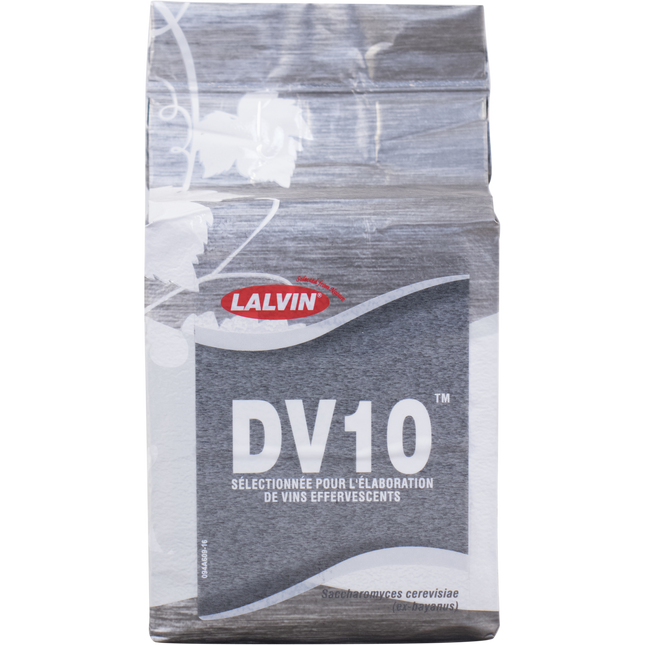
Lalvin DV10™ | Dry Wine Yeast
Lalvin DV10 is the ideal choice for winemakers dedicated to producing elegant sparkling wines and bright, crisp still whites with clean aromatics and refined structure Whether perfecting a classic Champagne, refining a crisp Chardonnay, or creating a beautifully structured sparkling wine, DV10 guarantees clarity, balance, and exceptional quality Precision, stability, and clean fermentation for premium sparkling and still wines Lalvin DV10 is a robust and versatile yeast strain, originating from the Champagne region of France. Renowned for its clean fermentation profile and high alcohol tolerance, DV10 is ideal for producing sparkling wines, Champagne, and crisp still whites. Its consistent performance under challenging conditions makes it a preferred choice for winemakers seeking reliability and clarity in their wines . Clean Fermentation Profile: Produces minimal volatile acidity and low hydrogen sulfide (H₂S), preserving pure fruit character and aromatic clarity. High Alcohol Tolerance: Effective up to 18% ABV, supporting complete fermentation in high-sugar musts. Temperature Range: Performs optimally between 50°F (10°C) and 95°F (35°C), suitable for both cold fermentations and warm climates. Attenuation Rate: Typically achieves 85–90% attenuation, ensuring a crisp, dry finish. Low SO₂ Production: Maintains bright, clean aromatics with minimal sulfite interference. High Flocculation: Settles efficiently post-fermentation, ensuring bright clarity. Applications: Sparkling Wines: Perfect for Méthode Traditionnelle, Charmat Process, and Pet-Nat styles, delivering fine bubbles and crisp aromatics. Champagne Production: Reliable under high pressure and low temperatures, producing elegant mousse and clean expression. Still Whites: Ideal for Chardonnay, Sauvignon Blanc, and Pinot Grigio, preserving bright fruit and crisp acidity. High-Alcohol Fermentations: Excellent for fortified wines and late-harvest styles, with complete sugar conversion and balanced structure. Flavor Profile: Crisp Apple & Citrus: Sharp notes of green apple, lemon zest, and grapefruit dominate the palate. Mineral Freshness: Subtle minerality that enhances clean mouthfeel and bright finish. Floral & Light Herbaceous Notes: Delicate hints of white blossom and cut grass contribute to aromatic lift. Bright, Crisp Finish: Ensures a clean, refreshing palate with high clarity and purity. Usage: Rehydration: Rehydrate in 10 times its weight of chlorine-free water at 104°F (40°C) for 15–20 minutes. Stir gently to prevent clumping. Pitch Rate: Use 1–1.5 grams per gallon (0.25–0.4 grams per liter) for optimal fermentation and flavor development. Nutrient Addition: Supplement with yeast nutrient to optimize fermentation strength, especially in high-Brix musts. Fermentation Temperature: Maintain between 50°F and 95°F to optimize ester formation and maintain aromatic clarity. Secondary Fermentation: Perfect for bottle conditioning and sparkling wine production, supporting fine bubbles and bright clarity. Download the PDF Download the PDF
$2.99
-
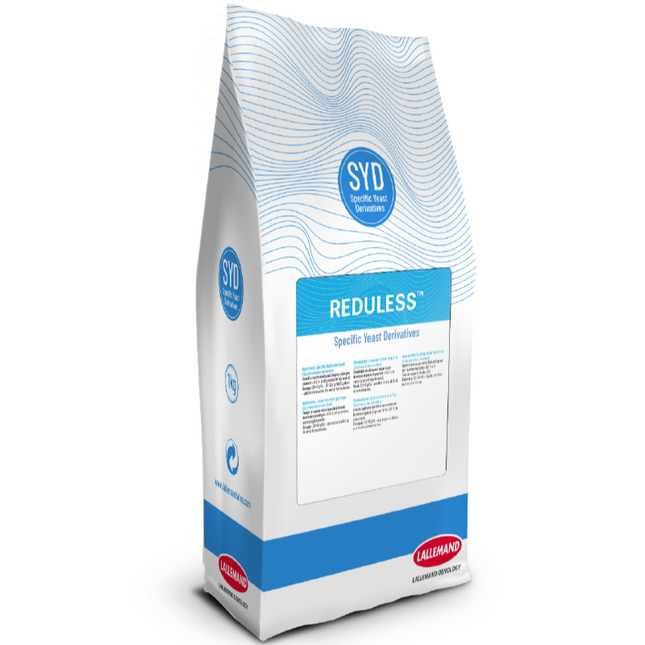
Lallemand Reduless | Inactivated Yeast with Copper | Fixes H2S Issues
Reduless is a new product from Lallemand that was designed to correct negative VSCs (Voltatile Sulfur Compounds) such as H2S (hydrogen sulfide, A.K.A. "rotten egg") and DMS (dimethyl sulfide, A.K.A. "cooked corn") defects in wine. Made from inactivated yeast that have been infused with copper using a proprietary process, Reduless is a much gentler H2S remedy on the wine than the traditional copper sulfate (CuSO4) treatment alone. If you have an H2S problem, then we recommend treating it with Reduless first. However, if the sulfur problem still remains after the Reduless treatment, then a bench trial with copper sulfate (CuSO4) is recommended. Note: The sooner you catch a sulfur problem the easier it is to deal with! To Use: Dissolve Reduless in 10 times it's weight in water and add immediately to the wine. Stir the wine gently to ensure a thorough homogenization. Rack or filter after 72 hours. Recommended Dosage: 0.4-0.6 g/gal. The maximum amount of copper that can be released into the wine using Reduless at the recommended dosage is 0.02 ppm.
$2.49
-

Stavin French Oak Cubes | Medium Plus Toast
Medium Plus toast cubes manufactured by StaVin. Cubes have a longer contact time than traditional chips do, which make them better for long-term aging of wines and beers. Also, longer contact time means longer extraction of flavors (3-6 months), which leads to a more complex combination of flavors. Chips are usually done giving flavor after a week, there by contributing a harsh, flat oak flavor.
$9.99
-

Stavin American Oak Cubes | Medium Plus Toast
Due to high demand, some of these items are currently out of stock but available for pre-order. Please check status notes below when selecting a size option to see if it is In Stock or tagged as PreBook. We will automatically ship this to you when we receive more inventory. Medium Plus toast cubes manufactured by StaVin. Cubes have a longer contact time than traditional chips do, which make them better for long-term aging of wines and beers. Also, longer contact time means longer extraction of flavors (3-6 months), which leads to a more complex combination of flavors. Chips are usually done giving flavor after a week, there by contributing a harsh, flat oak flavor. Our cubes are fires toasted and cut by Stavin, a leading supplier of high-quality oak alternatives to top commercial wineries. Download the PDF
$4.69
-
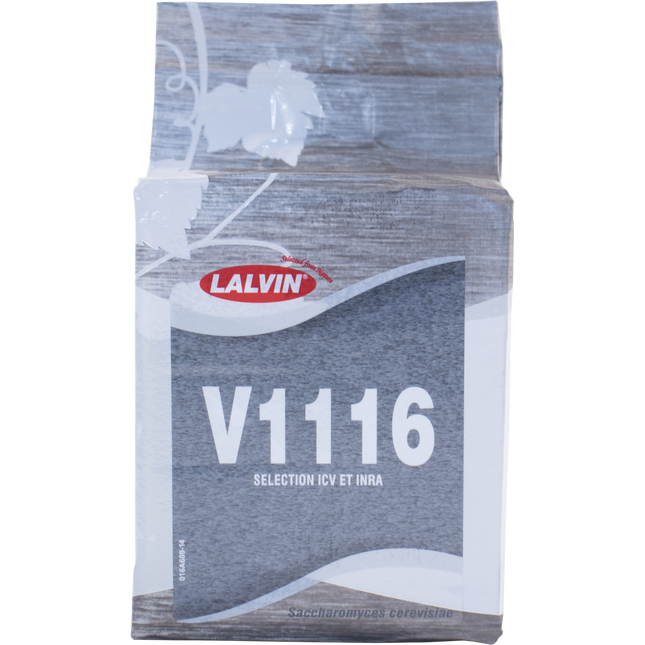
Lalvin K1 (V1116) | Dry Wine Yeast
Lalvin K1 (V1116) is the perfect choice for winemakers aiming to craft fresh, aromatic white wines and vibrant fruit-based fermentations Whether perfecting a crisp Chenin Blanc, crafting a sparkling wine, or fermenting a bright fruit wine, K1 (V1116) delivers unmatched clarity, brightness, and aromatic intensity in every batch Enhance freshness and aromatic intensity in white wines and fruit fermentations Lalvin K1 (V1116) is a robust and versatile wine yeast strain, selected by the Institut Coopératif du Vin (ICV) in Montpellier, France. Renowned for its strong fermentation kinetics and high ester production, K1 (V1116) is ideal for crafting crisp white wines, sparkling wines, and fruit-based fermentations. Its resilience under challenging conditions makes it a reliable choice for both professional and home winemakers. High Ester Production: Enhances floral and fruity aromas, including notes of apple, citrus, and tropical fruits. Cold Fermentation Tolerance: Performs well at low temperatures, preserving delicate aromatics. Alcohol Tolerance: Effective up to 18% ABV, allowing for complete fermentation in high-sugar musts. Fermentation Range: Operates optimally between 50°F (10°C) and 95°F (35°C), providing flexibility across various wine styles. Low Nutrient Requirements: Thrives in musts with low nutrient content, reducing the need for supplementation. Low H₂S and SO₂ Production: Ensures clean fermentations with minimal off-flavors. Applications: White Wines: Sauvignon Blanc, Chenin Blanc, Riesling, and Pinot Grigio, where bright fruit and floral characteristics are desired. Sparkling Wines: Suitable for traditional method and Charmat process, promoting fine bubbles and crisp acidity. Fruit Wines: Enhances the natural fruit expression in apple, pear, peach, and berry wines. Mead and Cider: Promotes clean, crisp fermentations with bright aromatics. Flavor Profile: Bright Citrus & Apple: Sharp notes of green apple, lemon zest, and lime. Tropical Fruit Hints: Subtle expressions of pineapple and passion fruit. Floral Undertones: Light notes of honeysuckle and orange blossom contribute to aromatic lift. Clean, Crisp Finish: Maintains a fresh, pure expression of fruit with minimal sulfur notes. Usage: Rehydration: Rehydrate in 10 times its weight of chlorine-free water at 95°F (35°C) for 15–20 minutes. Stir gently to avoid clumping. Pitch Rate: Use 1–1.5 grams per gallon (0.25–0.4 grams per liter) for optimal fermentation and flavor development. Nutrient Addition: While K1 (V1116) has low nutrient requirements, supplementation is recommended in low-nitrogen musts to prevent sluggish fermentation. Fermentation Temperature: Maintain between 50°F and 95°F to optimize ester formation and maintain clarity. Download the PDF Download the PDF
$2.49
-

Viniflora® CH35 | Dry Malolactic Bacteria | 1.5 g
Selected and adapted especially for direct inoculation of rose and white wines Strong fermenter under harsh white wine conditions Direct inoculation, freeze-dried bacteria – does not require rehydration High numbers of active cells which ensure a quick start of fermentation Good for 66 gallons Viniflora CH35 is a freeze-dried culture of Oenococcus oeni. This malolactic bacteria has been selected and adapted especially for direct inoculation of rose and white wines. Viniflora CH35 has been selected for its outstanding performance in malolactic fermentation of difficult white wines. This strain is the perfect match for rose and white wines but can also be used with success in red wines. Application: Viniflora CH35 should be added to dry wine, right after the alcoholic fermentation. No rehydration or reactivation is required. For more information about ML Bacteria, please see MoreWine!'s Guide to Malolactic Fermentation. Characteristics: Outstanding tolerance to low pH and elevated levels of SO2 (down to pH 3.0 and up to 50ppm!) Strong fermenter under harsh white wine conditions Clean and fruity flavor profile No production of biogenic amines High inoculation level encourages a completed malolactic fermentation 14% alcohol tolerance Key Features: Recommended for white wines Direct inoculation, freeze-dried bacteria – does not require rehydration High numbers of active cells which ensure a quick start of fermentation This strain is pH tolerant to 3.0, Total SO2 to 45 ppm (white wines), temperature 59 – 77 ͦF and alcohol to 14% (v/v) Low level of volatile acidity Cinnamoyl Esterase Negative
$31.99
-
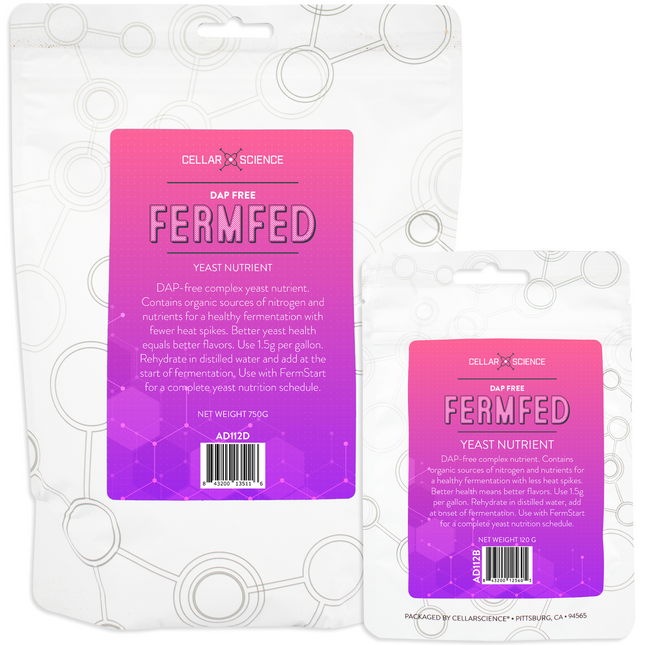
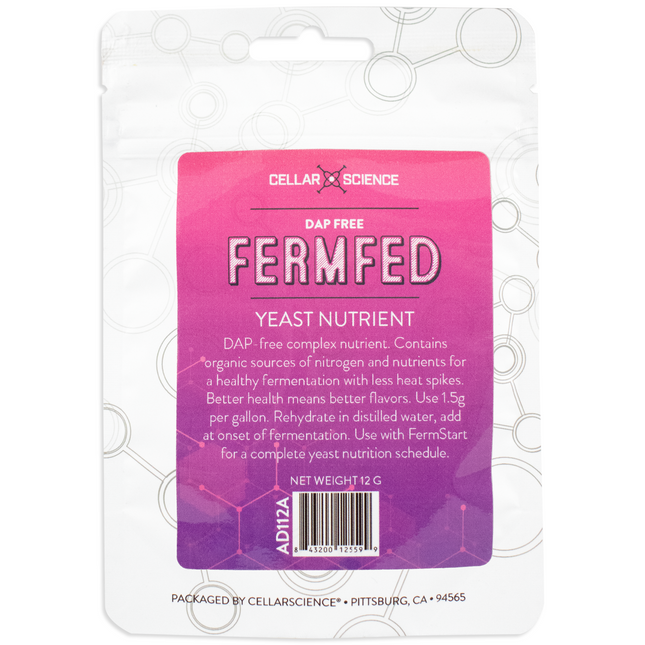
CellarScience® FermFed DAP Free | Yeast Nutrient
Feed your fermentation with FermFed DAP Free by CellarScience®. The 100% natural formulation of FermFed DAP Free is derived from the autolysis of very specific yeast strains naturally high in free amino acids, sterols, mannoproteins, zinc, magnesium, and niacin, along with vitamins B1, B2, B5, B6, and B12 for a complete yeast health regimen. As the name suggests, this unique formulation does not contain the traditional inorganic diammonium phosphate, but does provide organically derived nitrogen. How Much Do I Add and When? The recommendation that covers most fermentations is to add 1.5 gram per gallon of FermFed DAP Free at the onset of fermentation and then add 1 gram per gallon of FermFed after 1/3 sugar depletion. Mix the nutrients in a small slurry of water and add to the fermentation. Read more below if you are interested in measuring YAN (Yeast Available Nitrogen) and adjusting your nutrient schedule accordingly. The Science of How it Works The different components of FermFed DAP Free work in different ways to feed and protect your yeast. The complex and organic nitrogen in FermFed DAP Free helps eliminate excessive yeast growth in the initial phases, reducing fermentation heat spikes at the start of fermentation. Included sterols make the yeast membrane more resistant to alcohol and to high temperatures. The collection of B-vitamins along with zinc and magnesium are essential for enzymatic activity, alcohol tolerance, and yeast health. Mannoproteins help avoid the aromatic stripping during the fermentation by binding esters and terpenes and not allowing them to be driven off by CO2. The included yeast hull components act as receptors to bind up fatty acids that can accumulate and cause stuck fermentations. Advanced - Adjusting Your Nutrient Schedule Based on YAN (Yeast Available Nitrogen) In addition to the nutrients provided by FermFed or FermFed DAP Free, yeast need a certain level of nitrogen to perform adequately. If deprived of nitrogen, yeast are more likely to produce off flavors, most notably hydrogen sulfide. When added at the rate of 1 gram per gallon, FermFed provides 38ppm of YAN while FermFed DAP Free adds 20ppm when added at the rate of 1.5 gram per gallon. How much YAN do you need? Acceptable levels range from 175 to 300ppm. YAN levels in grapes vary, with grapes from warmer climates often having less. The best practice is to measure your grapes using a commercial wine lab or the Vinmetrica YAN Test Kit along with a Vinmetrica Meter. If you know your YAN the following is a good general guide: 175ppm or above = FermFed DAP Free @ onset + FermFed DAP Free @ 1/3 completion (adds 40ppm YAN) 150ppm or above = FermFed DAP Free @ onset + FermFed @ 1/3 completion (adds 58ppm YAN) 125ppm or above = FermFed @ onset + FermFed @ 1/3 completion (adds 72ppm YAN) Below 125ppm = FermFed @ onset + FermFed @ 1/3 completion + extra DAP For a full yeast nutritional plan, use FermStart when rehydrating your yeast, use FermFed DAP Free at the onset of fermentation, and use FermFed after 1/3 sugar depletion.
$2.49
-
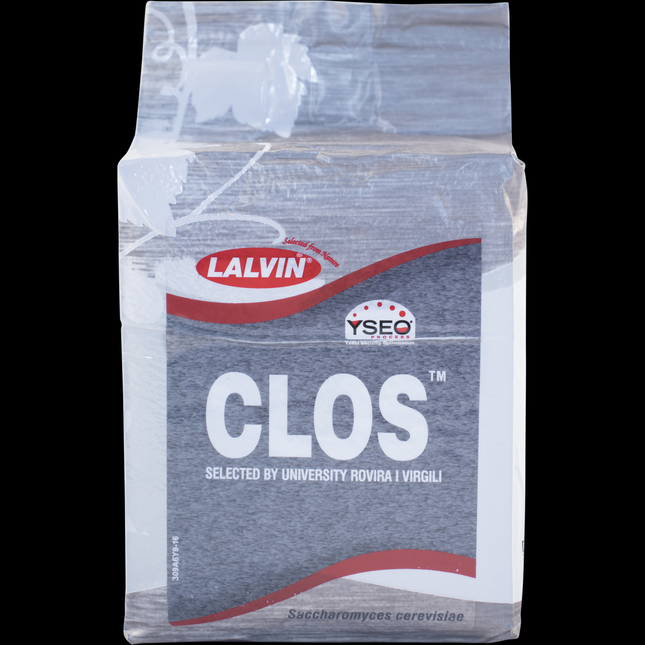
Clos Dry Wine Yeast
Clos is a yeast strain isolated from the Priorat region of Spain. Clos was chosen for its ability to re-enforce structure while emphasizing aromatic complexity and mouthfeel. Sweet red fruit (cherry), with pepper and chocolate notes are typical of what Clos brings to a fermentation. With hot climate/high Brix fruit, Clos is a great choice for its high alcohol tolerance (17%), low Nitrogen needs and short lag phase. Clos also does well with higher fermentation temperatures (max 95 F) and shows a good compatibility with MLF. Highly recommended for Syrah, Petite Syrah, Grenache, Tempranillo and Carignane. Download the PDF Download the PDF
$2.99
-
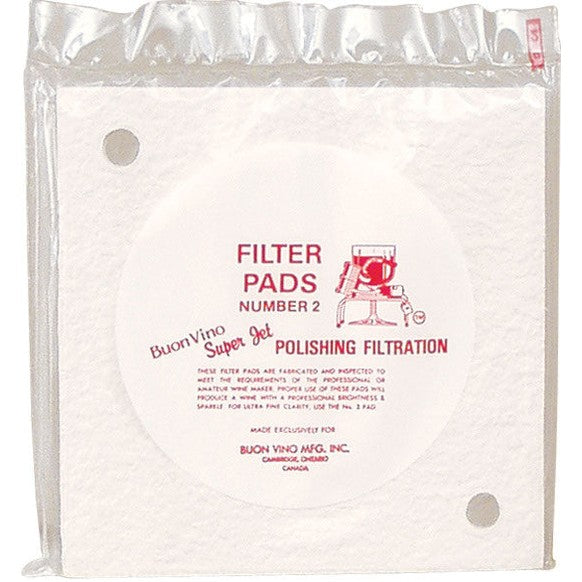
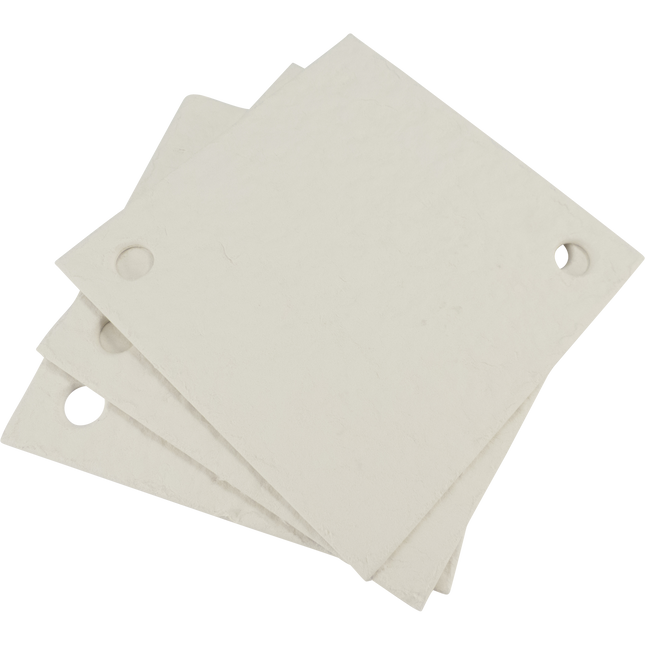
Buon Vino Super Jet Filter Pads - Fine (Number 2)
20 x 20 cm custom Filter Pad for use specifically with the Buon Vino Super-Jet Filter. Pads are rated nominally, which means that the rating is an average of all of the sizes of pores in the media. Fine pads are rated to 2 microns nominal, and are appropriate for polish filtration of red and white wines. Typically the finest filtration a red wine will go through.
$6.49
-
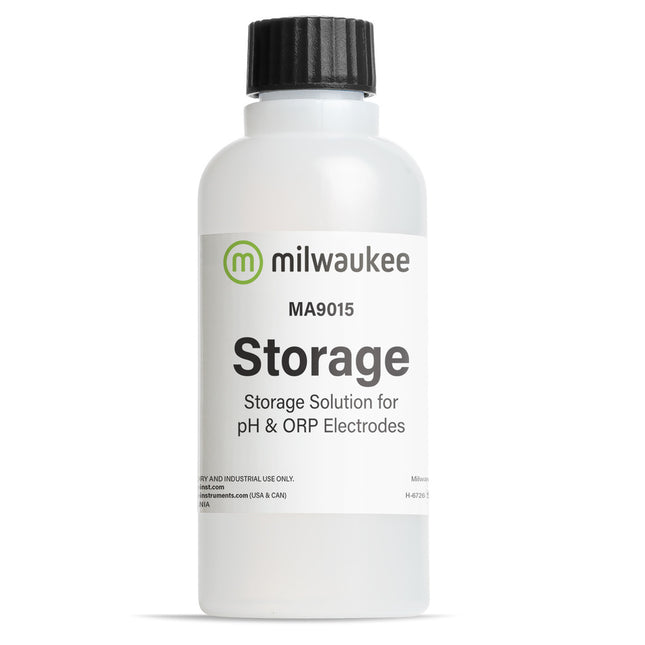
Milwaukee Storage Solution for pH/ORP Electrodes
For long term health of your elctrode use pH storage solution. It is a mixture of Potassium Chloride, Postassium Hydrogen Phthalate, Silver Nitrate, and Sodium Hydroxide. Volume: 230 ml Download the PDF
$16.70
-

Stavin Hungarian Oak Cubes | Medium Plus Toast
Medium Plus toast cubes manufactured by StaVin. Cubes have a longer contact time than traditional chips do, which make them better for long-term aging of wines and beers. Also, longer contact time means longer extraction of flavors (3-6 months), which leads to a more complex combination of flavors. Chips are usually done giving flavor after a week, there by contributing a harsh, flat oak flavor. Download the PDF
$4.69
-


Red Star | Premier Rouge (Pasteur Red) | Dry Wine Yeast
Red Star Pasteur Red has been rebranded as Premier Rouge but is the same exact yeast stratin. Known as a strong fermenter for producing full bodied reds, especially good with grapes from the Cabernet and Zinfandel families. Ferments from 60 to 80 degrees. Download the PDF
$1.79
-


WineStix - Medium Toast French Oak Carboy 2 Pack
WineStix are a new form of oak integration for wine, designed to give new barrel flavors with an extraction time similar to cubes. The combination of Short and Long grains result in amazing gradience of flavor similar to barrels, while extracting significantly quicker! These are Medium toast French Oak staves, and depending on the wine, will impart flavors of vanilla and coffee, while clearing out negative vegetal flavors and astringency from the wine. This is a two pack of WineStix, sized specifically for a 5-6 gallon carboy of wine. WineStix will easily fit through the mouth of a glass carboy, and can be attached to a string via the drilled hole for easy removal! One carboy Winestix will treat 5-6 gallons of wine.
$15.99
-

Tannin Riche Extra
This product replaces our TAN140 - Tannin Plus Enological tannins offer the winemaker the possibility to add refined, highly-bindable tannin to your wine at any stage during the process. Benefits can include increased structure and mouthfeel, color stabilization, stability, anti-oxidative qualities, and overall complexity. Tannins can reduce vegetal/herbaceous characteristics and perceived astringency. We offer four types of oenolgical tannins, two for use during fermentation, and two for use during the aging phase. Aging Tannins Tannin Riche Extra is a preparation of 100% American oak tannin that has been lightly toasted to impart a soft, aromatic character while enhancing the structure and organoleptic complexity of a wine. Tannin Riche Extra is a great tool for imparting hints of coconut, a heightened vanillin oak character and a smooth finish to your wines. Although designed for fine-tuning a wine, Tannin Riche Extra still maintains the regular properties associated with the use of tannins such as helping with clarification, stability, oxidation, and aging. Works well in conjunction with low doses of other tannins (i.e: Tannin Complex & FT Blanc Soft). To Use: Dissolve the tannin in 10 times its weight in warm water (95F/35C). Add to the wine during a punch-down or pump-over for good mixing. Addition of Tannin Plus should be made a minimum of three weeks before bottling. Recommended dosage: 0.2-0.4 g/gal A rough approximate of weight is 3/4 tsp = 1 gram. We highly recommend using a scale to weigh the product for an accurate dose. We do not recommend relying on these rough conversions for accurate dosage rates.
$4.99
-
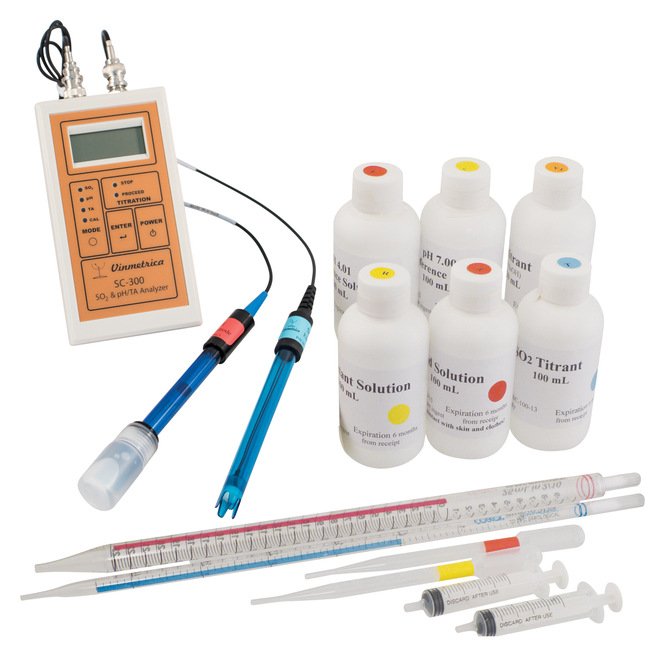
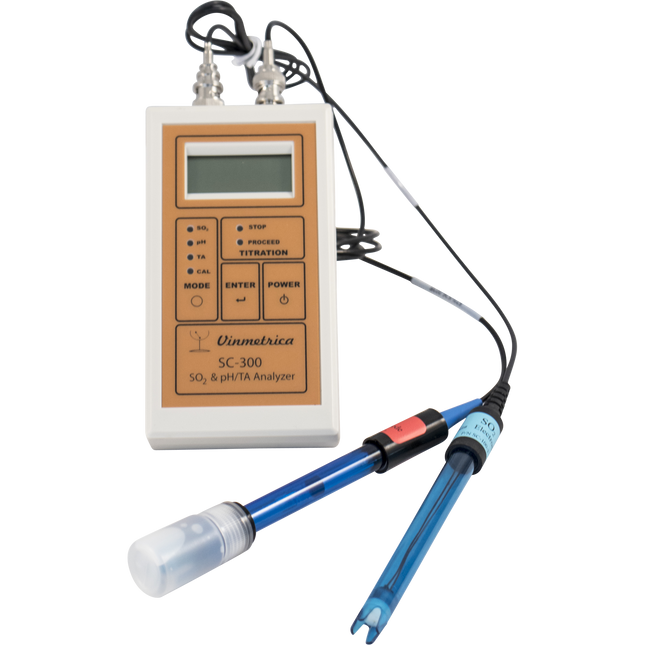
Vinmetrica SC-300 | Complete Wine Testing Kit | Sulfite (SO2), pH & Titratable Acidity (TA) Analyzer Kit
The Ultimate Winemaker’s Companion! Includes everything you need to analyze SO2, pH, and TA in one kit Tests take less than 2 minutes to perform and are incredibly accurate with pH readings to 1/100 of a point Combines the SO2 detection of the SC-100A and the pH/TA analysis of the SC-200 into one compact instrument Audible buzzer and indicator light alert you to when the test is complete Affordable wine analysis averaging roughly $1 per test One lean, mean wine analyzing machine. The SC-300 combines the SO2 detection of the SC-100A and the pH/TA analysis of the SC-200 into one power-packed instrument. It’s built on the same hardware and software as our other two analyzers, so the accuracy is superb. And it’s just as easy to use – The audible buzzer and visual stop light will automatically let you know when you’re tests are done! Because it does not rely on a color change, the SC-300 eliminates the guesswork in Ripper sulfite tests, especially in red wines! Why Choose Vinmetrica’s SC-300? Where else will you find a single, compact instrument that can measure sulfite (SO2), pH and TA (Titratable Acidity) levels throughout the fermentation and aging process? Even in Red Wines! It’s Accurate: SO2: ± 2 ppm Free SO2. TA: ± 0.2 g/L Tartaric acid pH: better than ± 0.02 pH units Quick! – Less than 2 minutes per test! Affordable – About a $1 per test!* Easy to Use – No mystery solutions, pumps or tubing. *SO2 (Sulfite) Tests cost approximately 70¢ / Test (the cost of the reagents per test). If you do a combined pH and TA analysis, the cost of reagents for the pH/TA test is approximately $1.12 / Test. Complete Wine Testing Kit – Includes Everything Needed to Analyze Sulfite (SO2), pH and TA (Titratable Acidity) levels in Your Wines & Musts: SO2 reagents pH/TA reagents Two titration beakers Two 5 mL syringes Two transfer pipettes SO2 electrode pH electrode 25 mL sampling pipette (for SO2) 5 mL sampling pipette (for pH/TA) The SC-300 Operating Manual The SC-300 analyzer gives accurate SO2, pH and TA values. Kit includes everything to perform about 50 sulfite tests and 30 TA tests: both electrodes, all reagents, pipettes, syringe and beaker. A Quick Overview – Wine Analysis Procedures with the SC-300: Easy SO2 Test Attach SO2 electrode, press the power button, change to SO2 mode and press enter. Draw up 5 mL of titrant into the syringe and place 25 mL of wine in beaker. Add ~2 mL of the acidifier and ~2 mL of the reactant to wine. Place and hold the SO2 electrode in the wine sample and swirl beaker. Add titrant from syringe dropwise until 15 second long endpoint signal reached. Multiply the titration volume by 20, the SO2 conversion factor, results in ppm Free SO2. Simple pH Test Attach the pH electrode, set aside storage solution, rinse with DI water and blot gently with a paper towel. Press the power button then press the ‘Mode’ button and switch the SC-200 into ‘Cal’ mode. Calibrate using the pH 4 and pH 7 reference standards provided. Put the SC-200 in pH mode. Take 5 mL sample of wine, place in a beaker. Take a pH reading. Accurate TA Test For TA test, withdraw 5 mL of the TA Titrant with the syringe. Take 5 mL wine sample and add ~15 mL of deionized water. Put SC-200 into TA mode, place clean pH electrode gently in solution. Add TA Titrant from the syringe dropwise until the endpoint is reached indicated with the visual and audible signals. Record the volume (in mL) of titrant used. Multiply the titrantion volume by 2, the TA conversion factor, results in g/L Tartaric Acid. Vinmetrica Troubleshooting Guide
$695.00
-


CellarScience® FermFed | Yeast Nutrient
Help your yeast reach the end of fermentation safely while producing amazing flavors with FermFed by CellarScience®. Yeast that are given FermFed have a higher likelihood of fermenting without issue while producing wines with more intense flavors and aromas. FermFed is a complex nutrient blend of diammonium phosphate, thiamin, amino acids, sterols, pantothenic acid, mannoproteins, protective microelements derived from yeast hulls, and vitamins B2, B5, B6, & B12. FermFed also contains the organic and inorganic nitrogen (DAP) that yeast need. How Much Do I Add and When? The recommendation that covers most fermentations is to add 1 gram per gallon of FermFed DAP Free at the onset of fermentation and then add 1 gram per gallon of FermFed after 1/3 sugar depletion. Mix the nutrients in a small slurry of water and add to the fermentation. Read more below if you are interested in measuring YAN (Yeast Available Nitrogen) and adjusting your nutrient schedule accordingly. The Science of How it Works The different components of FermFed work in different ways to feed and protect your yeast. Grape must/juice is often deficient in assimilable nitrogen. When yeast do not have enough nitrogen, they are more likely to produce hydrogen sulfide (rotten eggs). FermFed helps to eliminate this problem by providing enough nitrogen for most situations. Yeast get weaker as they divide and multiply. They run the risk of not being able to properly finish fermentation as the alcohol content rises. Feeding them sterols help cells maintain membrane fluidity so that the yeast can properly function as alcohol and other harmful compounds in the fermentation conspire against them. Mannoprotein molecules bind esters and terpenes and work as an anchor to keep them in solution so they are not driven off by CO2 during fermentation. Pantothenic acid is added to help reduce the production of hydrogen sulfide. Thiamine is important for yeast metabolism. Vitamins B2, B5, B6, & B12 are important for general yeast health. Advanced - Adjusting Your Nutrient Schedule Based on YAN (Yeast Available Nitrogen) In addition to the nutrients provided by FermFed or FermFed DAP Free, yeast need a certain level of nitrogen to perform adequately. If deprived of nitrogen, yeast are more likely to produce off flavors, most notably hydrogen sulfide. When added at the rate of 1 gram per gallon, FermFed provides 38ppm of YAN while FermFed DAP Free adds 20ppm. How much YAN do you need? Acceptable levels range from 175 to 300ppm. YAN levels in grapes vary, with grapes from warmer climates often having less. The best practice is to measure your grapes using a commercial wine lab or the Vinmetrica YAN Test Kit along with a Vinmetrica Meter. If you know your YAN the following is a good general guide: 175ppm or above = FermFed DAP Free @ onset + FermFed DAP Free @ 1/3 completion (adds 40ppm YAN) 150ppm or above = FermFed DAP Free @ onset + FermFed @ 1/3 completion (adds 58ppm YAN) 125ppm or above = FermFed @ onset + FermFed @ 1/3 completion (adds 72ppm YAN) Below 125ppm = FermFed @ onset + FermFed @ 1/3 completion + extra DAP The best way for to test for YAN is using a lab or a home testing solution like this YAN kit from Vinmetrica. An acceptable level for YAN is between 200 to 350ppm FermFed provides 38ppm of Yan when added at the rate of 1 gram per gallon. The reason we don’t automatically use FermFed for a Stage 2 is that we don’t want to introduce excessive amounts of DAP into the wine if your yeast don’t need it. For a full yeast nutritional plan, use FermStart when rehydrating your yeast, use FermFed DAP Free at the onset of fermentation, and use FermFed after 1/3 sugar depletion.
$1.49
-

Lallemand Assmanshausen (AMH) | Dry Wine Yeast
Assmanshausen (AMH) is the ideal choice for winemakers seeking to produce elegant, terroir-driven red wines with aromatic complexity and structured tannins Whether perfecting a Pinot Noir, elevating the freshness of Gamay, or crafting a refined Burgundy-style blend, AMH consistently delivers elegance, balance, and nuanced flavor in every bottle Enhanced aromatics and structured tannins for elegant red wines Assmanshausen (AMH) is a specialty wine yeast strain prized for its ability to enhance aromatic complexity and develop structured tannins in cool-climate red wines. Originally selected from the Assmanshausen region in Germany, this strain is ideal for crafting elegant, age-worthy wines that benefit from extended fermentation and maceration periods. Its steady, controlled fermentation allows for nuanced expression of delicate fruit and spice characteristics. Enhanced Aromatics: Elevates subtle cherry, cranberry, and spice notes, ideal for cool-climate reds. Structured Tannin Development: Promotes refined tannin integration, enhancing mouthfeel and ageability. Alcohol Tolerance: Effective up to 14% ABV, suitable for balanced red wine styles. Temperature Range: Performs optimally between 59°F (15°C) and 82°F (28°C), allowing for slow, controlled fermentations. Low Flocculation: Extended suspension during fermentation aids in complex flavor development. Minimal SO₂ Production: Preserves clean aromatics and avoids off-flavors. Applications: Pinot Noir: Enhances delicate fruit and floral notes while promoting smooth tannin development. Gamay: Elevates fresh berry expressions and accentuates vibrant acidity. Cool-Climate Reds: Ideal for crafting structured, elegant wines that express terroir. Blended Reds: Perfect for Burgundy-style blends and Beaujolais Nouveau. Flavor Profile: Red Fruits: Highlights cherry, cranberry, and raspberry for a bright, aromatic profile. Spice and Floral Notes: Subtle expressions of clove, cinnamon, and violet enhance complexity. Silky Tannins: Promotes refined tannin structure for a smooth, elegant mouthfeel. Aging Potential: Supports graceful aging with layered complexity and aromatic depth. Guidelines: Rehydration: Rehydrate in 10 times its weight of chlorine-free water at 95°F (35°C) for 15–20 minutes. Stir gently to prevent clumping. Pitch Rate: Use 1–1.5 grams per gallon (0.25–0.4 grams per liter) for optimal fermentation and aromatic expression. Nutrient Addition: Supplement with yeast nutrients, particularly in low-nitrogen musts, to prevent sluggish fermentation. Fermentation Temperature: Maintain between 59°F and 82°F for optimal aromatic expression and structured tannin development. Extended Maceration: Suitable for long fermentations to develop depth and complexity. Download the PDF Download the PDF
$3.19
-
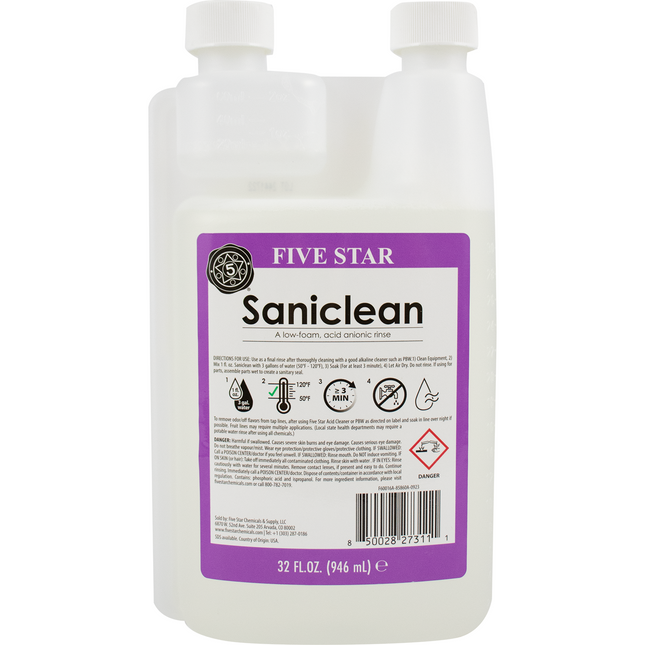
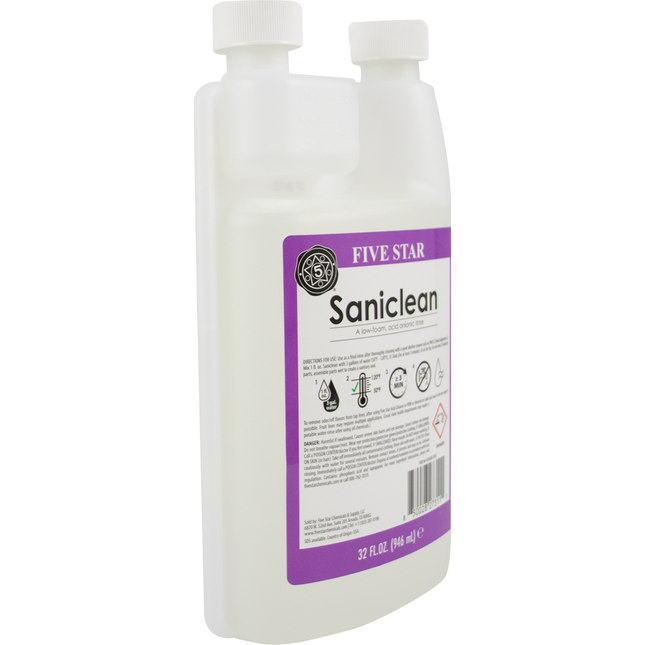
Five Star | Saniclean Sanitizer | Acid-Based Sanitizer | Low Foaming | Flavorless, Odorless, & Non-Toxic
SaniClean is the low-foam version of Star San. With a contact time of 2-3 minutes it is not as fast as Star San, but works as well. You also have to use twice as much, 2 oz per 5 gallons, for the same effect. However if you are using a pump it is the right choice. SaniClean is also known as a flavor and odor removal, making it the perfect choice for acid rinsing your dispensing equipment. Made by the same company that makes Star San and PBW and packaged in the same easy to use container as the 32 oz Star San. Please note: Due to DOT HAZMAT shipping restrictions, orders for 15-gallon, 55-gallon, or multiple 5-gallon units will require freight shipping. These sizes are intended for commercial use. HAZMAT items are not able to be returned.
$25.99
-

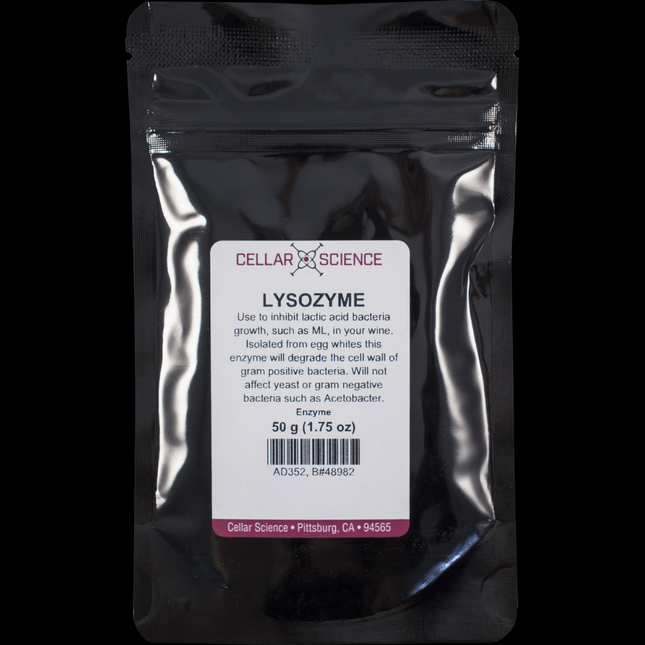
Delvozyme® (Lysozyme)
Wine Making Use Delvozyme (Lysozyme, Lysovin) for controlling lactic acid bacteria growth in your wine. Isolated from egg whites, this enzyme will degrade the cell wall of gram positive bacteria, but will not affect yeast or gram negative bacteria such as Acetobacter. Delvozyme can be used for both Red and White Wine Malo Fermentation. Dosage: To Delay Malolactic Fermentation: Red Wine - add to grapes at 100 - 200 ppm, or 0.38 - 0.76 grams per gallon. White Wine - Add to must at 200 - 300 ppm, or 0.76 - 1.14 grams per gallon. To Block Malolactic Fermentation: White Wine - Add to must or wine at 300 - 500 ppm, or 1.14 - 1.90 grams per gallon. Stabilizing wine after MLF is complete: Add to barrel during storage at 250 - 500 ppm, or 0.95 - 1.90 grams per gallon. When blending partial and complete MLF wines: Add immeditatley after blending at 300 - 500 ppm, or 1.14 - 1.90 grams per gallon, to reduce the risk of further malolactic fermentation (MLF). Within several days any lactic should expire. For sluggish or stuck yeast fermentation: Red Wine - Add at 150 - 400 ppm, or 0.57 - 1.52 grams per gallon. White Wine - add at 300 - 500 ppm, or 1.14 - 1.90 grams per gallon. Directions for use: You can make a 10% solution of Delvozyme in water (100 grams per liter of water). However we find the easiest method is to add the desired dry weight of Lysovin in 5x its weight of warm(tepid) water. Mix for one minute, allow this mixture to stand for 45 minutes and add to must, juice or wine while mixing well. Allow 24 - 48 hours for reaction to complete. **Note: 3tsp Delvozyme = 5g Beer Making Delvozyme can be used in beer making as well. Use either in the starter (recommended if you make starters) or when pitching (adding) the yeast to the wort, do not use over 140 F. Recommended dosages is 1 tsp per 5 gallons of wort. According to studies it has no effect on flavor or clarity. Storage: Should be stored at room temperatures in a dry environment, can be stored up to 5 years.
$34.99
-
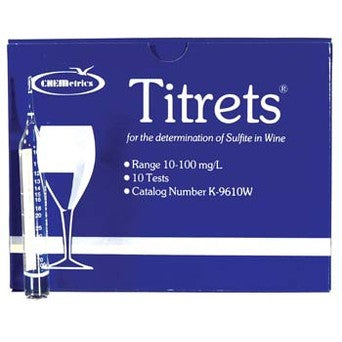
Sulphite Test Kit
Used to determine the level of SO2 in your wine. Contains 10 tests in the form of glass titrets. They can be used by themselves or you can purchase W510B which is a titret holder. Please keep in mind that due to some chemical interference, this kit is only accurate to within +/- 30ppm when used to test red wines. Please note: the box states that this test kit is to be used with white wines only. However, we have found the kit can still be used for red wines as well. Titration tests are based on chemical reactions that cause a color change in the sample. This color change, which is much more obvious in white wine samples, will be harder to detect when used with red wine samples.
$22.99
-

Glass Marbles For Topping Up - 3 lbs
Clear glass marbles are a great choice for filling up volume in a small fermenter or oak barrel. Most of us have been in that situation where we have the ideal container we want to use to store our wine, but we just don't have quite enough wine. What are your choices? Either use several smaller containers, buy wine to top up, or try to purge the air space with inert gas. None of these are ideal solutions. Clear glass marbles, free of ink or contamination, are an ideal solution. Use just as much as you need to top up the vessel. When you transfer the wine out, remove your marbles, wash and reuse with your next batch (just don't lose them...) 3 lbs of marbles is enough to fill approximately 1 Liter in volume, while displacing roughly 0.6L of liquid. Specifications Count: Approximately 615 Net Weight: 3 lbs Marble Size: 12mm Color: Clear Volume Displaced: About 0.6 L
$19.99
-

WineStix - Medium Plus Toast French Oak Carboy 2 Pack
WineStix are a new form of oak integration for wine, designed to give new barrel flavors with an extraction time similar to cubes. The combination of Short and Long grains result in amazing gradience of flavor similar to barrels, while extracting significantly quicker! These are Medium Plus toast French Oak staves, and depending on the wine, will impart roasted toasty aromas, with flavors of coffee and caramel sweetness the length of the palate. This is a two pack of WineStix, sized specifically for a 5-6 gallon carboy of wine. WineStix will easily fit through the mouth of a glass carboy, and can be attached to a string via the drilled hole for easy removal! 1" W x 8.5" Long One carboy Winestix will treat 5-6 gallons of wine.
$15.99
-


W15 Dry Wine Yeast
A fructophile for clean, low temperature ferments. W15 was isolated in 1991 from high quality Muller Thurgau must originating in the vineyards at the Viticulture Research Station in Wadenswil, Switzerland. W15 was developed to ferment dry whites at moderate speeds where bright fruit and heavy mouthfeel are desired. This yeast does just that, and it does so while respecting the varietal characteristics of the fruit. W15 can also be used to ferment high quality, fruit focused, light red wines from Pinot Noir and cool-climate Syrah. Short lag pahse, moderate rate fermenter at temperature ranges between 50 to 81 degrees F. Alcohol tolerant to 16%. W15 produces higher levels of glycerol and succinic acid especially at higher fermentation temperatures (above 77 degrees F). Download the PDF Download the PDF
$2.99
-

Heat Shrink Sleeves - Matte Red
These PVC heat shrink capsules help to make your home made wine look classy and professional. The look is the closest we have seen to commercially used tin capsules, which must be spun on with a $2,000 machine. Conversely, these PVC capsules can be easily used at home. Features horizontal tear tab. To use, slide on to top of wine bottle and dip into hot water for a quick and even shrink. Or for faster processing with a more reliable finish try one of our Heat Shrink tools. 2 1/4" Height x 1 1/4" Diameter.
$1.79
-
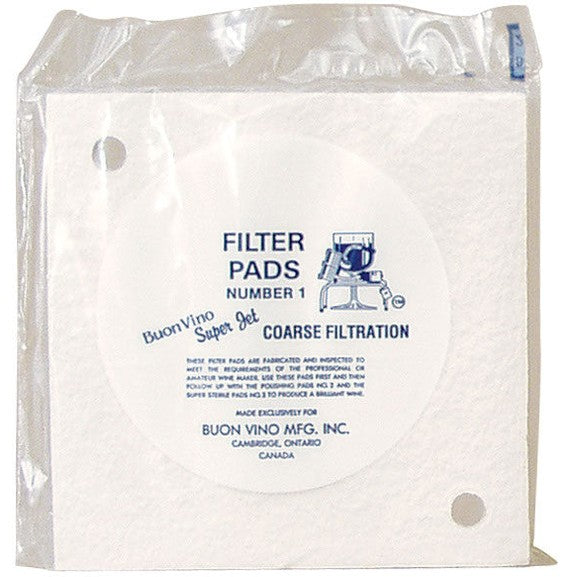
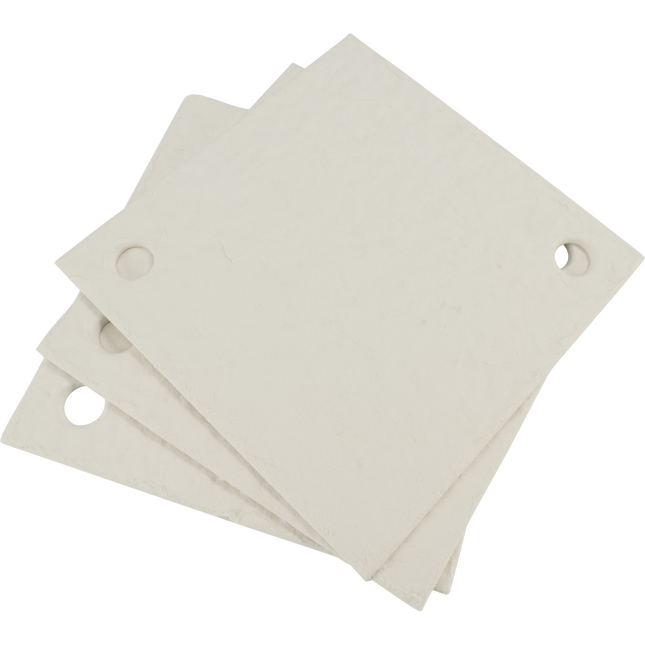
Buon Vino Super Jet Filter Pads - Coarse (Number 1)
20 x 20 cm custom Filter Pad for use specifically with the Buon Vino Super-Jet Filter. Coarse pads are rated to 7 microns nominal, and are appropriate for initial clearing of red and white wines when particularly cloudy. With a nominal rated pad some material below the rating will be trapped and some material above the rating will be allowed to pass, the 7 micron represent an average.
$6.49
-

Xoakers - French Oak, Medium Plus
Xoakers are 1" Solid Oak spheres made from high quality French oak and seasoned for a minimum of 24 months. They will contribute a complex oak character while softening and rounding the wine as well. What sets these apart though, are their shape and ease of use. The uniform size allows for precise dosing, and easy removal once complete. Whether you are using carboys or neutral barrels, additions are as simple as counting out however many Xoakers you need, and tossing them in. Every vessel will be oaked to the same extent when using these, and no need to weigh them out! Removing them is as simple as turning over your carboy or barrel, and watching them roll out! These can be used in both red and white wines, and are perfect for carboys, barrels, small tanks, and kegs. Ideal oak for the home winemaker! These Convection Toasted Medium Plus French Oak Xoakers are packed in Mylar bags, and will contribute various flavors depending on the wine. The 8 pack will treat 4-8 gallons & 1 lb will treat 35-70 gallons. Dosage: 1-2 Xoakers / Gallon (3.78 L) wine (depends on desired Oak Impact) Contact Time: 4 Month Minimum Recommended Useful Life in Wine: 12 Months Size: 1" Diameter Spheres, 70 French Oak Xoakers / lb Liquid Displacement: .10 gal (.41 L) Toast Level: Med +
$9.49
-


Lalvin CY3079™ | Dry Wine Yeast
Lalvin CY3079 is the go-to choice for winemakers aiming to craft full-bodied, complex Chardonnay and barrel-aged whites with rich mouthfeel, creamy texture, and elegant oak integration Whether perfecting a Chardonnay or refining a white Burgundy, CY3079 ensures a smooth, layered finish with exceptional aromatic clarity Enhance complexity and mouthfeel in premium Chardonnay and barrel-aged whites Lalvin CY3079 is a specially selected wine yeast strain renowned for its ability to develop rich mouthfeel, enhanced complexity, and buttery characteristics during fermentation. Perfectly suited for Chardonnay and other barrel-aged white wines, CY3079 promotes the release of polysaccharides and encourages malolactic fermentation, resulting in wines with balanced acidity, smooth texture, and vibrant aromatics. Enhanced Mouthfeel: Promotes polysaccharide synthesis, delivering a creamy, full-bodied texture. Malolactic Compatibility: Optimized for seamless transition into malolactic fermentation, enhancing buttery and nutty notes. Aromatic Development: Elevates apple, pear, vanilla, and toasted almond aromatics. Alcohol Tolerance: Supports ABV levels up to 15%, allowing complete fermentation in high-sugar musts. Attenuation Rate: Typically achieves 85–90% attenuation, ensuring a dry, well-structured finish. Temperature Range: Performs optimally between 59°F (15°C) and 77°F (25°C), with the best expression of mouthfeel and complexity around 64°F (18°C). Medium Flocculation: Settles well post-fermentation, enhancing clarity and reducing sediment. Applications: Chardonnay: Ideal for barrel-fermented Chardonnay, bringing forward rich mouthfeel and buttery notes. White Burgundy: Elevates minerality and complexity, emphasizing ripe fruit and toasty oak integration. Viognier: Enhances stone fruit and floral notes, adding depth and roundness. Barrel-Aged Whites: Perfect for oaked Sauvignon Blanc and Semillon, adding creaminess and layered complexity. Flavor Profile: Stone Fruits & Citrus: Boosts expressions of apple, pear, and lemon zest. Buttery & Nutty Notes: Develops butter, vanilla, and toasted almond during malolactic fermentation. Rich Mouthfeel: Promotes a creamy, well-rounded palate with smooth, integrated texture. Oak Integration: Complements toasted oak, enhancing complexity and balance. Usage: Rehydration: Rehydrate in 10 times its weight of chlorine-free water at 95°F (35°C) for 15–20 minutes. Stir gently to avoid clumping. Pitch Rate: Use 1–1.5 grams per gallon (0.25–0.4 grams per liter) for optimal mouthfeel and flavor development. Nutrient Addition: Supplement with yeast nutrient to optimize fermentation and promote aromatic development. Fermentation Temperature: Maintain between 59°F (15°C) and 77°F (25°C), with 64°F (18°C) being ideal for creaminess and complexity. Barrel Fermentation: Ideal for in-barrel fermentations to enhance oak integration and complexity. Download the PDF Download the PDF
$2.99
-


Wine Corks - Aglica
An agglomerated cork that offers a great seal using compressed pieces of small cork. Fantastic value. Because they do not compress as easy as natural corks, you will need a floor corker, as opposed to a handcorker, to push these into the bottles.
$6.99
-


58W3 Dry Wine Yeast
A yeast strain that really brings out aromatic components in white wines, especially Pinot Gris, Gewurztraminer, Riesling, Viognier and Semillion. Also a great choice for mead fermenations where it has a significant aroma/flavor input. Specifically Fruity/Floral aromas are emphasized through the natural liberation of terpenes found in these varieties. What we think is particularly unique about this strain is the creation of smoky/spicy aromas. Also selected as a commercial yeast strain for its ability to create mouthfeel volume and richness. So to recap - fruity/floral/smoky/spicy aromas and flavors with good mouthfeel... where do we sign up! Lallemand recommends adding Go-Ferm during rehydration and Fermaid K to the ferment to ensure that this strain ferments to dryness. Download the PDF Download the PDF
$3.19
-

American Medium Toast Oak Chips
Our high quality, yet inexpensive American oak chips. These are toasted to a Medium Toast.
$2.39
-
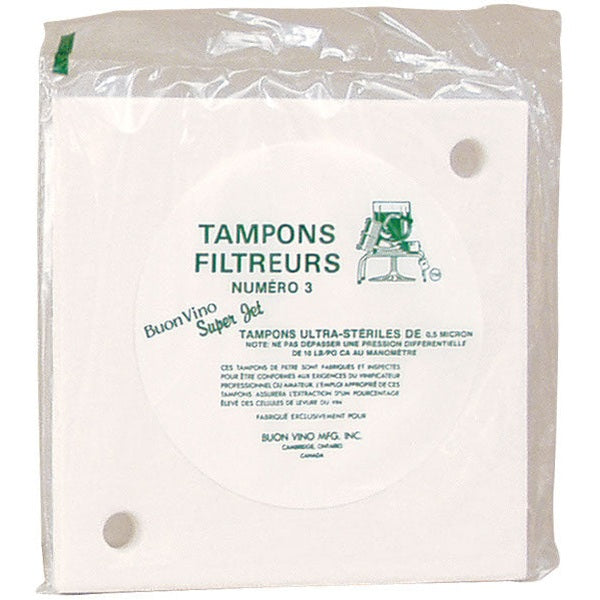
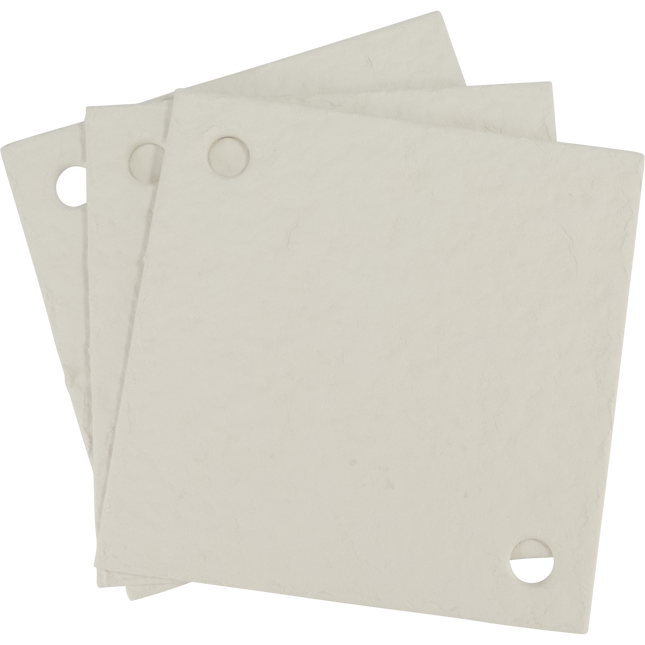
Buon Vino Super Jet Filter Pads - Sterile (Number 3)
A .5 micron pad used for final filtration. When using the Buon Vino Super Jet Filter with sterile pads a homewinemaker will want to "pre-filter" the wine with polish pads (FIL16) otherwise you will certainly have early clogging issues. . The sterile filters clog too fast when there is any sediment present.
$9.49
-

Vinyl Transfer Tubing | Flexible | Racking | 3/8 in. ID | 1/2 in. OD
Thin walled tubing perfect for siphoning or tranferring liquids when not under pressure. This is the most common size hose for homebrewing that you would need to fit onto the plastic spigots (FE347), 3/8'' OD bottle fillers, and the 3/8'' OD racking canes. 3/8" ID, 1/2" OD 1/8" thick wall
$2.69
-
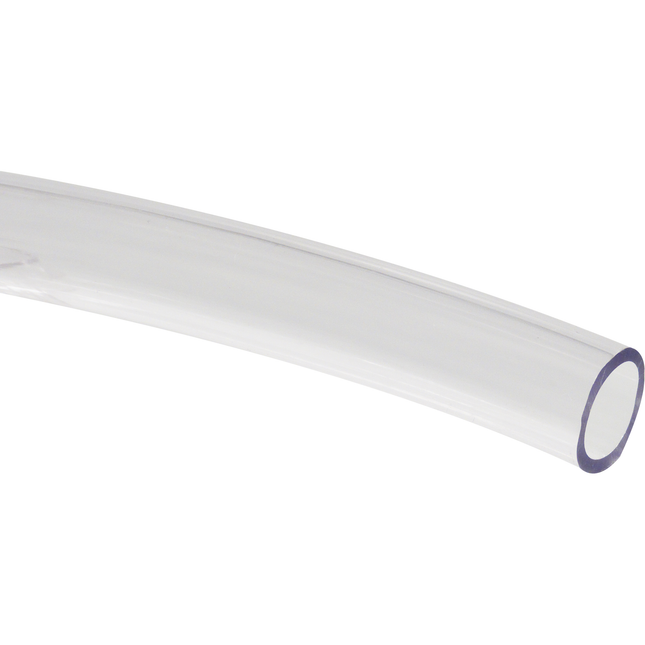
Vinyl Transfer Tubing | Flexible | Racking | 1/2 in. ID | 5/8 in. OD
Use for the 1/2'' OD racking cane and 1/2'' OD bottle fillers.
$3.69
-


Lallzyme Cuvee Blanc | Fermentation Enzyme for White Wines
Lallzyme Cuvee Blanc – Enzyme for Aroma Release and Finesse in White and Sparkling Wines Enhances aroma expression by unlocking bound terpene and thiol precursors Improves clarification and filterability through efficient pectin breakdown Increases finesse and texture by gently releasing polysaccharides Ideal for varietal whites and sparkling base wines where delicacy is key Balanced glycosidase activity preserves freshness without compromising stability Lallzyme Cuvee Blanc is a highly specific enzyme developed by Lallemand for the production of elegant, aromatic white and sparkling wines. It offers a delicate balance of pectinase and glycosidase activity that breaks down grape cell walls to improve clarification while simultaneously releasing aroma precursors trapped in glycosidic form. This selective activity enhances varietal expression—especially in terpene- and thiol-rich varieties—without producing off-flavors or excessive bitterness. The result is a wine with lifted aromatics, better mouthfeel, and improved stability, ideal for styles requiring precision and finesse. Protocol Dilute Lallzyme Cuvee Blanc in 10 times its weight of chlorine-free water. Add to juice or wine at the preferred stage—either pre-fermentation for aroma release and settling, or post-fermentation for finishing and clarification. Ensure even distribution by mixing thoroughly. Optimal temperature range is 12–20°C. Avoid use below 10°C or in combination with bentonite or SO₂ during addition. Usage Rates Recommended dosage: 2–4 grams per hectoliter = 0.02–0.04 grams per liter = 0.076–0.151 grams per gallon Use 2 g/hL for lighter aromatics or wines already showing good varietal character. Increase to 4 g/hL in more neutral juices or when maximizing aromatic potential is desired. Allow adequate contact time—typically 24 to 48 hours—depending on the winemaking stage and style.
$2.99
-

Economy Sulfur Burner
A stainless steel mesh basket with cylindrical disc bottom that is suspended by a stainless rod from a silicone bung. The sulfur disc is placed in the basket where it burns. Drips from the burning sulfur are caught on the bottom. Dimensions: Cage: 2"h x 1 1/2"d Bung (silicone): 2 1/4"d (top), 1 3/4"d (bottom) x 1/2"h Length of Basket and stem: 13"
$51.99
-

Glass Jug w/ Screw Top Finish | Finger Grip Handle | Clear | 1 Gallon | 128 oz
1 gallon glass jug that works well for small batch fermentations of beer, mead, wine and More! Clear glass allows you to monitor fermentation activity as it happens Accepts 38mm screw cap or can be used with a #6 stopper and airlock Great for splitting 5 gallons of wort into small batches to perform yeast experiments Sold individually or in cases of 4 with dividers A handy 1 gallon glass jug that is perfect for a small batch of wine! Our 1 gallon glass jar works great for holding small amounts of wine or mead for aging, small batch fermentation, overflow storage and fermentation experiments. Some Suggested Uses: Use to store excess wine when you press off and have more than you expected. Ferment small batches of mead, sake, fruit wine or anything else that strikes your fancy! Perform yeast experiments - split a batch of beer into five 1 gal batches and ferment them with different yeast strains Uses a #6 stopper. Please Note: DOES NOT INCLUDE LID
$8.99
-

Acid Blend
A 1/3 mix each of citric, tartaric and malic acids. Primarily used in fruit wines to adjust acid levels. A rough approximate of weight is 1 tsp = 3 grams. We highly recommend using a scale to weigh the product for an accurate dose. We do not recommend relying on these rough conversions for accurate dosage rates.
$2.49
-
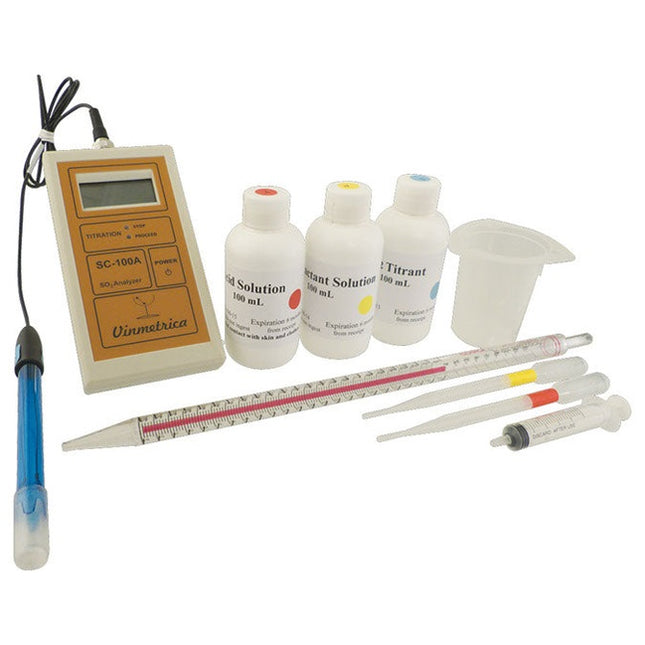
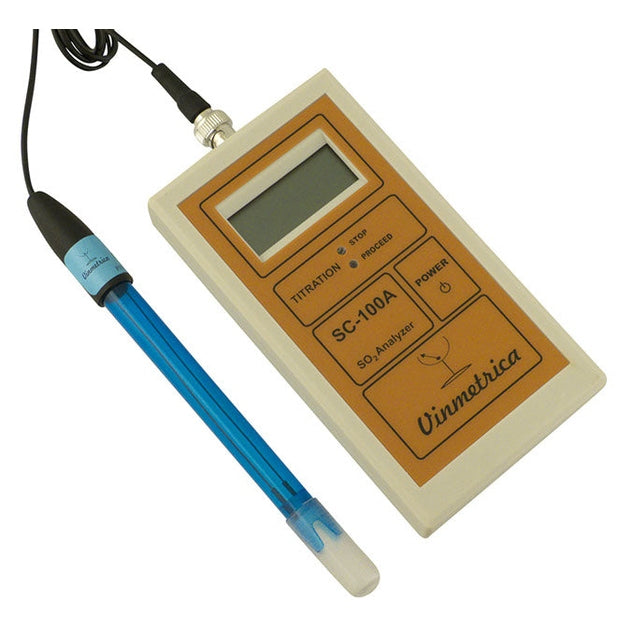
Vinmetrica SC-100A SO2 Analyzer Kit
The SC-100A puts you in control of your wine sulfite analysis. It’s highly accurate and sensitive titration system conveniently alerts you visually and audibly when the endpoint is detected by its electrode. Because it doesn’t rely on a color change, the SC-100A eliminates the guesswork in Ripper sulfite tests, especially in red wines! The SC-100A analyzer gives you confidence to run your sulfite assays accurately and quickly. Kit includes everything to perform approx. 50 tests: electrode, reagents, pipettes, syringe and beaker. How It Works: The SC-100A improves on the tried and true Ripper Method by eliminating the guesswork in colorimetric analysis and replacing it with digital detection indicators. It uses an amperometric electrode and replaces the iodine reagent with a more stable reagent. Its ease of use and accurate amperometric titration method vastly improves on the original Ripper Method. The SO2 Titrant reacts with the sulfite in the wine. When all the free SO2 is titrated, the endpoint is signalled by visual and audible indicators. The test endpoint is much more sensitive than the starch endpoint commonly employed for sulfite titrations. It’s sharp and clear, even when titrating red wines and musts. Once the syringe titration is complete, determine the titration volume (which is the difference of titrant you started with and its final reading on the syringe) and multiply it by 20 (the conversion factor). The conversion factor takes into account the known concentration of the titrant and some simple unit conversions to determine the ppm Free SO2 in your wine sample. So for example if you used 1.2 mL of SO2 Titrant during the titration, your equation would look like this: 1.2 mL X 20 = 24 ppm Free SO2 Simple To Use Attach SO2 electrode, press the power button, change to ‘SO2′ mode and press enter. Draw up 5 mL of titrant into the syringe. Then place 25 mL of wine in beaker. Add ~2 mL of the acidifier and ~2 mL of the reactant to wine. Place and hold the SO2 electrode into the wine sample and swirl beaker. Add titrant dropwise, pause when device beeps, until 15 seconds of beeps reached. Multiply the titration volume by 20, the SO2 conversion factor, results in ppm Free SO2. Complete Kit Includes Everything You Need for Your First 50 Tests! SO2 reagents Titration beaker 5 mL syringe SO2 electrode 25 mL sampling pipette 2 transfer pipettes Vinmetrica Troubleshooting Guide
$392.00
-

Sulfur Discs (5 Gram)
Burn the correct amount of sulfur in your 60 gallon barrel using this easy-to-use disc. Ideally sized for 60 gallon barrels, or break the disc into smaller parts for use in smaller barrels. Used in conjunction with our sulfur burner.
$4.29
-

Heat Shrink Sleeves - Silver
These PVC heat shrink capsules help to make your home made wine look classy and professional. The look is the closest we have seen to commercially used tin capsules, which must be spun on with a $2,000 machine. Conversely, these PVC capsules can be easily used at home. Features horizontal tear tab. To use, slide on to top of wine bottle and dip into hot water for a quick and even shrink. Or for faster processing with a more reliable finish try one of our Heat Shrink tools. 2 1/4" Height x 1 1/4" Diameter.
$1.79
-


Lees Stirrer | Degasser | Stainless Steel | Folding Plastic Blades
Say goodbye to your days of picking up and shaking carboys. Use the Lees Stirrer to quickly and easily degas wine, stir your lees back into suspension, or mix in additives. Attaches to a drill for fast, easy stirring. The blades fold down so you can easily insert it into a barrel or glass carboy. When you turn the drill on, the blades expand to create a powerful stirring action. We do not recommend using in a carboy that is topped full. (The stirrer displaces too much liquid and creates a vortex that will send wine out of the top.) In these cases a hollow racking cane works exceptionally well. Works with 3/8" or larger drills. Stirrer is around 22" long.
$37.99
-


Viniflora® Oenos™ 2.0 | Dry Malolactic Bacteria | 1.5 g
Oenos™ 2.0 is an ideal strain to achieve a fast, clean malolactic fermentation in barrel aged wines Goes well with most grape varieties, but is mainly used in Cabernet Sauvignon, Syrah, Merlot, Malbec, Pinot noir, Gamay, Nebbiolo, Carignan, Tempranillo and Chardonnay Direct inoculation, freeze-dried bacteria – does not require rehydration High numbers of active cells which ensure a quick start of fermentation Good for 66 gallons Viniflora® Oenos™ 2.0 is a Oenococcus oeni selected for faster malolactic fermentation. Viniflora® Oenos™ 2.0 was launched in 2014 as a new generation of Viniflora® Oenos™. Viniflora® Oenos™ 2.0 fits the same specifications as Viniflora® Oenos™. However, it was selected for even faster malolactic fermentation (figure 1). This means that when a winemaker desires a fast, efficient and reliable malolactic fermentation Viniflora® Oenos™ 2.0 should be the first choose. For more information about ML Bacteria, please see MoreWine!'s Guide to Malolactic Fermentation. Characteristics: The go-to malolactic bacteria for safety and speed in a broad variety of wine styles Produces a medium amount of diacetyl Goes well with most grape varieties, but is mainly used in Cabernet Sauvignon, Syrah, Merlot, Malbec, Pinot noir, Gamay, Nebbiolo, Carignan, Tempranillo and Chardonnay Can be used for early co-inoculation, late co-inoculation as well as sequential inoculation Key Features: Recommended for white and red wines Direct inoculation, freeze-dried bacteria – does not require rehydration High numbers of active cells which ensure a quick start of fermentation This strain is pH tolerant to 3.2, Total SO2 to 40 ppm, temperature 62 – 77°F and alcohol to 15% (v/v) Low level of volatile acidity Cinnamoyl Esterase Negative
$23.99
-

Sulfur Discs (2.5 Grams)
Burn the correct amount of sulfur in your barrel using this easy-to-use disc. Ideally sized for 30 gallon barrels, or break the disc into smaller parts for use in smaller barrels. Used in conjunction with our sulfur burner.
$2.99
-

Heat Shrink Sleeves - Matte Green
These PVC heat shrink capsules help to make your home made wine look classy and professional. The look is the closest we have seen to commercially used tin capsules, which must be spun on with a $2,000 machine. Conversely, these PVC capsules can be easily used at home. Features horizontal tear tab. To use, slide on to top of wine bottle and dip into hot water for a quick and even shrink. Or for faster processing with a more reliable finish try one of our Heat Shrink tools. 2 1/4" Height x 1 1/4" Diameter.
$1.79
-
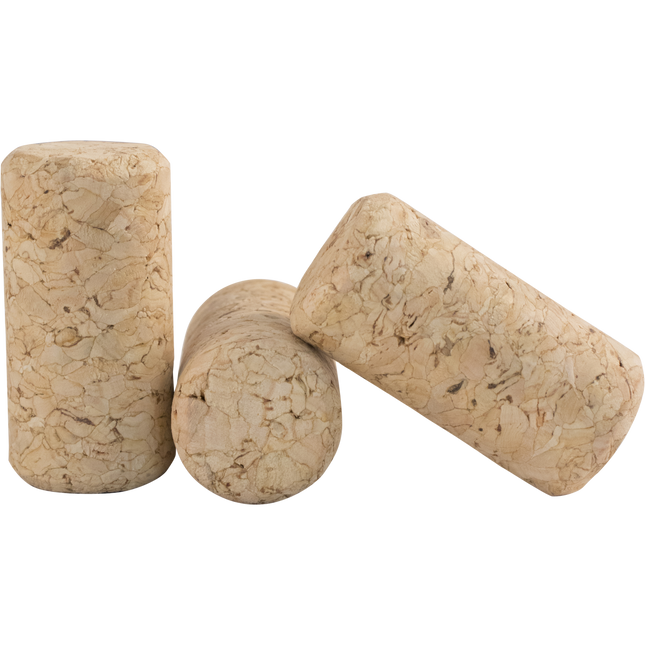

Wine Corks - #8 X 1-3/4 in Agglomerated
#8 agglomerated corks are slightly smaller than the standard #9 corks. They are often used with hand corkers that cannot compress the standard #9's, or for bottles with smaller necks. Agglomerated corks are made from small cork pieces held together with a food grade binder. Corks are treated with a food grade wax and silicone coating before being packaged by the manufacturer. To use, corks may be dipped briefly in a sanitizer solution and then corked immediately. Do not soak or boil corks as this can remove the silicone coating, making them difficult to remove from the bottles.
$6.49
-
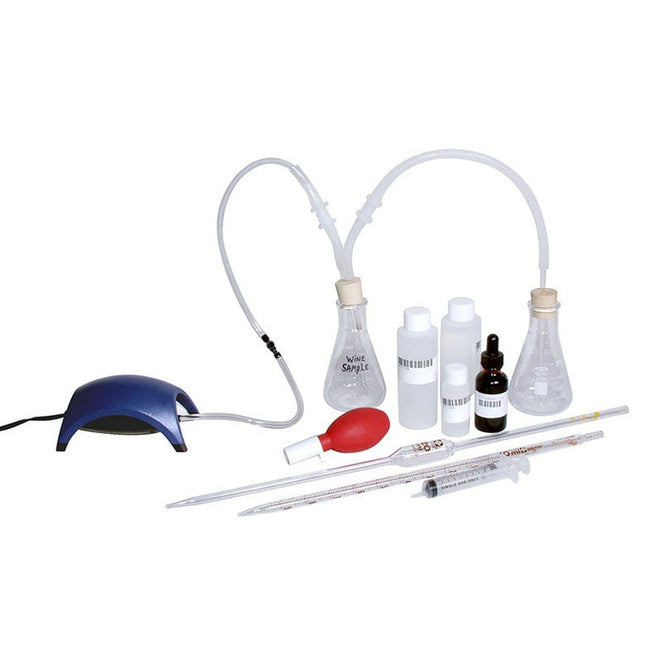
Economy Aeration-Oxidation Free SO2 Test Kit
Finally - Accurate & Affordable Free SO2 Testing! In winemaking, Sulfur Dioxide (SO2) is one of the most important and effective tools in the winemaker's arsenal for protecting against the effects of oxidative or microbial spoilage. Unfortunately, over time any SO2 added to a wine will be consumed due to its interaction with the very things that it is protecting the wine from. The ability to accurately monitor the amount of SO2 remaining available in a wine to protect it - termed Free SO2 - is hugely important when it comes to ensuring that the wine makes it through the aging process safely. For years MoreWine! has offered a variety of methods for testing the level of Free SO2 in a wine. Until now, winemakers had to make a choice between inexpensive test kits which lacked accuracy and kits which are highly accurate but cost hundreds of dollars. Now MoreWine! has developed an inexpensive AND accurate test kit which we feel has a place in every home winery. Based on the exact same science as our original Aeration-Oxidation test kit, our new Economy Aeration-Oxidation kit offers a high degree of accuracy for a fraction of the price. Aeration-Oxidation is the exact same testing method used in thousands of commercial wineries and wine analysis laboratories around the world. It is time-tested and proven accurate and is simple to perform. Our kit includes: All the glassware and tubing needed to set up a 2-chamber test apparatus Pipettes to accurately measure your wine sample and chemicals An aspiration pump to drive the chemical reaction in the test method Enough chemical reagents to run 2-3 tests Clear and comprehensive instructions for setting up and running the system PLEASE NOTE: This kit ships with a small bottle of 25% phosphoric acid which is required for the test. At this strength phosphoric acid is considered a hazardous material and we are not certified to ship larger quantities. We recommend that you investigate the possibility of sourcing it locally, through a laboratory supply company. If this is not possible, you can purchase it through us; see part #s MT108DS & MT108BDS. The high cost of these bottles reflects the $20 surcharge which FedEx adds to handle a hazardous shipment. These bottles ship directly from our supplier's warehouse and will take a couple of extra days to arrive. Click here to download a copy of our instruction manual for this kit.
$134.99
-
Polycacel
This product replaces our FIN73 - Polylact Polycacel can be used both curatively and preventatively against browning and pinking in white juice or in wine under long term storage conditions. Polycacel helps improve wine color and overall organoleptic properties. A is a blend of polyvinylpolypyrolidone (PVPP), soluble postassium casein and micropulverized cellulose. This specific blend allows for more complete action on phenolic compounds while avoiding over-stripping the wine. To Use: Slowly mix Polycacel in 20 times its weight in cold water (do not use juice or wine). Allow the mixture to stand for 2 hours. For enhanced homogenization, gradually add the Polycacel to the wine container while mixing. Dosages: To protect from oxidation, add to wine and mix thoroughly: 150-300 ppm To treat oxidized juice, add during cold settling: 300-700 ppm
$5.99
-


Natural Wine Corks | Premium Grade 1 | Molinas MP 1N | #9 x 1.75" | 24mm x 44mm
Natural cork is the preferred traditional cork of professional winemakers Grade 1 (rated 0-10) is popular for wineries looking to age High end cork for extended aging 24mm X 44mm, #9 x 1.75" | Fits standard cork finish (neck) bottles Recommended aging time: Up to 15 years Molinas Cork has been sustainabily harvesting from the cork forests of Sardinia for over 100 years Bark is aged an additional year prior to harvest, leading to less porous, higher quality cork Natural cork is the traditional and preferred cork of professional winemakers across the globe. Grade 1 corks provide a supreme whole natural cork at a spectacular price. These grade 1 corks (rated from 0-10, 0 being best) are a great option for most bottlings, including extended aging (5-15 years). 24mm X 44mm, #9 x 1.75". Fits standard cork finish (neck) bottles. Italy produces more wine than any country in the world and Molinas is the largest Italian cork supplier with over 1 billion corks produced annually. Molinas Cork was started over 100 years ago by Pietro Molinas on the Italian island of Sardinia. Besides its beautiful beaches and designation as one of the world's five Blue Zones, Sardinia is known for its large, government protected Cork tree forests. Today, the 4th generation of the Molinas family sustainably harvests cork from these protected trees. Compared to most cork available in the market, the bark is allowed to mature an additional year. This leads to a less porous, higher quality cork, and has less impact on the forest. Throughout the entire process from tree to finished cork, quality control is strictly monitored. MoreFlavor! is proud to represent Molinas Cork in the USA. Tolerances on Normal Dimensions: Height: +/- 0,4 mm Diameter: +/- 0,3 mm Humidity: Min: 3% Max: 8% Ovalization: ≤ 0,5 mm Characteristics Physical / Mechanical / Sensory: Peroxides: < 0,2 mg/stopper Dust transfer: < 1,5 mg/stopper Extraction force: 30 +/- 10 (daN) Organoleptic test: < 2% Finishing Treatments: Genesis Steam Treatment to Reduce Cat and Other Volatile Substances. Washing: with h2o2 solution in white or diluted with peracetic acid for natural color. Drying: Hot Air Forced To Eliminate Peroxide Residues. Thermal or ink marking on specific request. Silicone lubricant and adhesives with food certification for food contact.
$18.99


You have seen 96 out of 3969 products